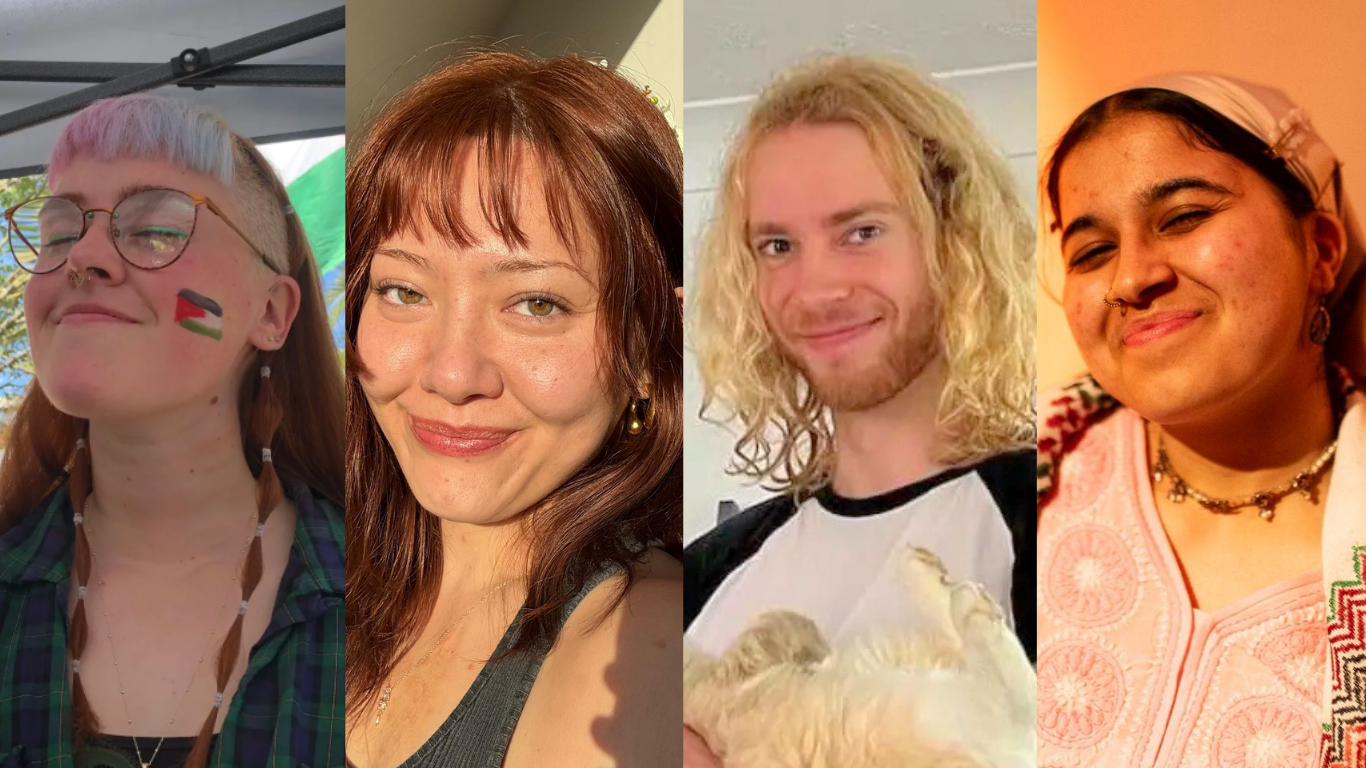

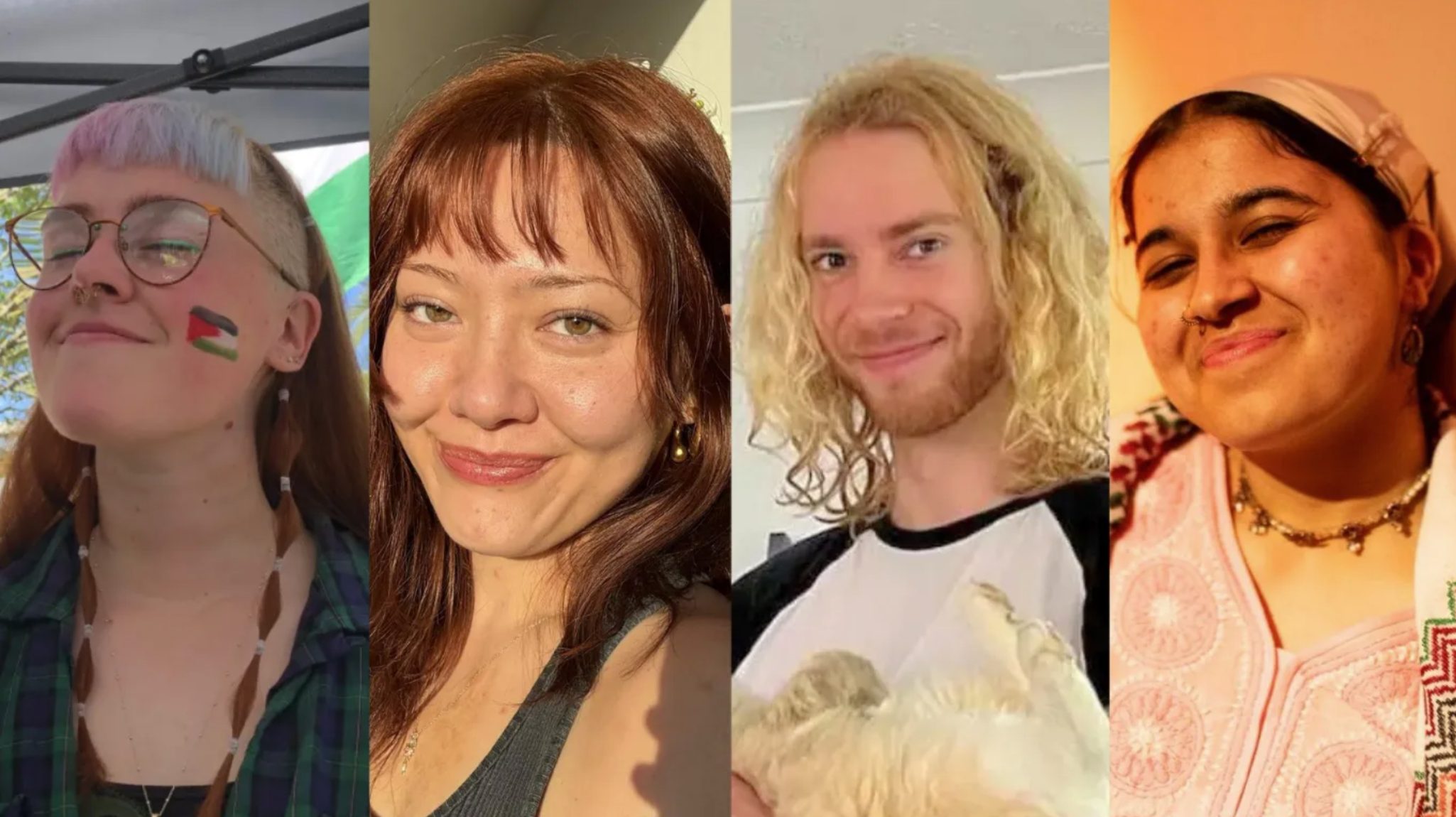
Photo: The Filton 4, from left to right: Charlotte (Lottie) Head, 29; Leona (Ellie) Kamio, 30; Sam Corner, 23; and Fatema Rajwani, 21.
The Guardian reports: “A judge has imposed lengthy custodial sentences on four Palestine Action activists who smashed up drones and other equipment at an Israeli arms manufacturer’s UK factory [Elbit Systems in Filton, Bristol] after ruling that there was a ‘terrorist connection’ to their offending.”
This is said to have been the first time in British history that someone accused of criminal damage has been sentenced as a terrorist.
Providing additional context, Andrew Feinstein, the Executive Director of the London-based non-profit Shadow World Investigations that exposes the illicit global weapons trade, has stated: “These quadcopter drones are key instruments of genocide, used by the Israeli forces in Gaza for surveillance, targeting and to kill.”
The Guardian adds: “Representing [Charlotte Head, 29], Rajiv Menon KC had told [the judge, Mr Justice Johnson] that it was unprecedented for the prosecution to apply for a judge to sentence a defendant as a terrorist for a non-violent offence.” Menon further argued that it would be “perverse” to find who, was motivated by humanitarian concern about “an arms company trading in death and destruction”, to have a terrorist connection. Head was sentenced by Mr Justice Johnson to five years in prison.
The Guardian also reports: “In written arguments, Mira Hammad KC, representing [Leona Kamio, 30, who was sentenced to five years], said the defendants had initially been arrested on suspicion of involvement in acts of terrorism but not charged with those offences… [And] Tom Wainwright KC, representing [Samuel Corner, 23, who was sentenced to seven years and eight months], said a terrorist connection finding against the defendants would also mean the suffragettes, the Greenham Common women and the Trident Ploughshares movement were terrorists.”
Open Letter from lawyers: An open letter signed by more than 50 lawyers and legal experts says: “Blurring the distinction between principled direct action and terrorism is the hallmark of authoritarian regimes.” Al Jazeera notes: “The letter has been signed by law professors from universities in the UK, the Netherlands, Norway and Canada as well as by dozens of practising barristers and solicitors.”
Defend Our Juries: A spokesperson for Defend Our Juries also told The New Arab: “Sentencing people as terrorists for damaging the weapons of genocide is not acceptable in a democracy and is inconsistent with the rule of law.” Defend Our Juries also posted: “Saving Lives Is Not Terrorism.”
Good Law Project: The Good Law Project says: “This grotesque distortion of the law tightens the screws on the public’s right to protest, placing more limits on our freedom to fight injustice.”
Public figures: Artists for Palestine also posted: “Sally Rooney, Greta Thunberg, Steve Coogan, and Lord John Hendy KC are among around 100 public figures warning of a miscarriage of justice if four human rights defenders receive unprecedented terrorism sentences for taking action against an Israeli arms manufacturer.”
Amnesty International UK: And Kerry Moscogiuri from Amnesty International UK said: “Today’s sentencing hearing risks marking a new low in the ongoing crackdown against protest across the UK. Criminal damage has never been treated as terrorism within the UK justice system before, and it is completely disproportionate to do so because the offence occurred at a protest.” Amnesty International UK further posted on social media: “Today’s decision shows how direct action protesters could be treated in the future. The use of terrorism laws against direct action protesters must end. Together we must continue calling out the abuse of power and fighting for our right to protest.”
Tayab Ali: Additionally, Tayab Ali, Partner at Bindmans LLP, further observed: “Meanwhile – British citizens suspected of war crimes as part of the IDF have been sentenced to 0 years imprisonment. In fact no one has even been investigated.”
We continue to follow this situation in the UK for any implications it may have on sentencing and the criminalization of protest in Canada.
—
OPEN LETTER FROM LAWYERS AND LEGAL EXPERTS
On 12 June, the Crown Prosecution Service will apply to have four young people (Charlotte Head, Leona Kamio, Fatema Zainab Rajwani and Samuel Corner) sentenced as terrorists, solely on the basis of their convictions for criminal damage. This is the first time, in British legal history, that such an application has been made in this context.
Damage to property has been a recurring feature of protest campaigns from the Suffragettes and the women of Greenham Common to Extinction Rebellion and the Trident Ploughshares movement. Military equipment has often been the target. Indeed the subject matter of the case in R v Jones, famous for Lord Hoffman’s dicta on civil disobedience, concerned extensive damage to military aircraft destined to support the invasion of Iraq. The defendants in that case were sentenced with conditional discharges.
It has never previously even been suggested that those taking such action should be treated as terrorists. Blurring the distinction between principled direct action and terrorism is the hallmark of authoritarian regimes.
The prosecution’s application is based on the motivation of the defendants, which was to prevent drones being used to kill civilians in Gaza. According to Mr Justice Johnson, in a preliminary ruling, such a motivation is consistent with section 1 of the Terrorism Act, and thereby capable of establishing a ‘terrorist connection’ for the purposes of The Sentencing Act 2020, section 69(3):
“On s1(1)(b) of the TA 2000, Rajiv Menon KC and others strongly argued that influencing government was not the purpose of the action – the purpose of the action was to damage weapons and save lives – I accept that this was one motivating factor – but that does not mean that another purpose was not to damage property to be made available to the Israeli government and thereby influence the Israeli government”.
In this analysis it is the motivation to “influence the Israeli government” to stop killing Palestinians, which justifies treating convictions for criminal damage as being on a par with acts of terrorism. That cannot be right.
If the prosecution application is successful, the Filton 4 will be sentenced as terrorists: their jail sentences will be extended, early release provisions disapplied, and upon eventual release they could be licensed as terrorists for up to 15 years, requiring them to register any new device, bank account, email, or relationship with the police.
Such an outcome would be wrong in principle for the following reasons:
i) The conscientious motivation of the defendants, which was to save lives and to uphold international law, is a mitigating factor, and it would be perverse, and contrary to basic legal principle, to treat it as an aggravating factor.
ii) It would be wrong to disregard the findings of various international bodies and legal scholars to the effect that the Government of Israel is committing genocide, war crimes and crimes against humanity, imposing a moral, if not legal, obligation on all to intercede, in particular by stopping weapons reaching the genocidaires.
iii) It is wrong in principle to sentence people on an entirely different basis from that on which they were convicted (all the more where the potential for a terrorist sentence was actively concealed from the jury).
We note with concern reports of political interference in prosecutions concerning Palestine Action. We note also that one troubling legal precedent has already been set in these proceedings: the attempt to prosecute the lead defence counsel, Rajiv Menon KC, over his closing speech, following a procedure since ruled unlawful by the Court of Appeal.
We, the undersigned, consider it vital to the integrity of the criminal justice system that the Filton 4 are sentenced on the same basis that they were convicted, i.e. causing damage to drones and other property of an Israeli weapons manufacturer, with the conscientious motive of saving lives, upholding international humanitarian law and preventing unimaginable human suffering.
Signed:
Michael Mansfield KC, Barrister
Liz Davies KC, Barrister
Gudrun Young KC, Barrister
Penny Green, Professor of Law and Globalisation QMUL [Queen Mary University of London]
Declan Owens, Solicitor
David Whyte, Professor of Climate Justice QMUL
Neve Gordon, Professor of Human Rights and Humanitarian Law, QMUL
Yvette Russell, Professor of Law and Feminist Theory, University of Bristol
Bill Bowring, Barrister, Emeritus Professor of Law, Field Court Chambers, Birkbeck College
Richard Vogler, Emeritus Professor of Law, University of Sussex
and 48 others