


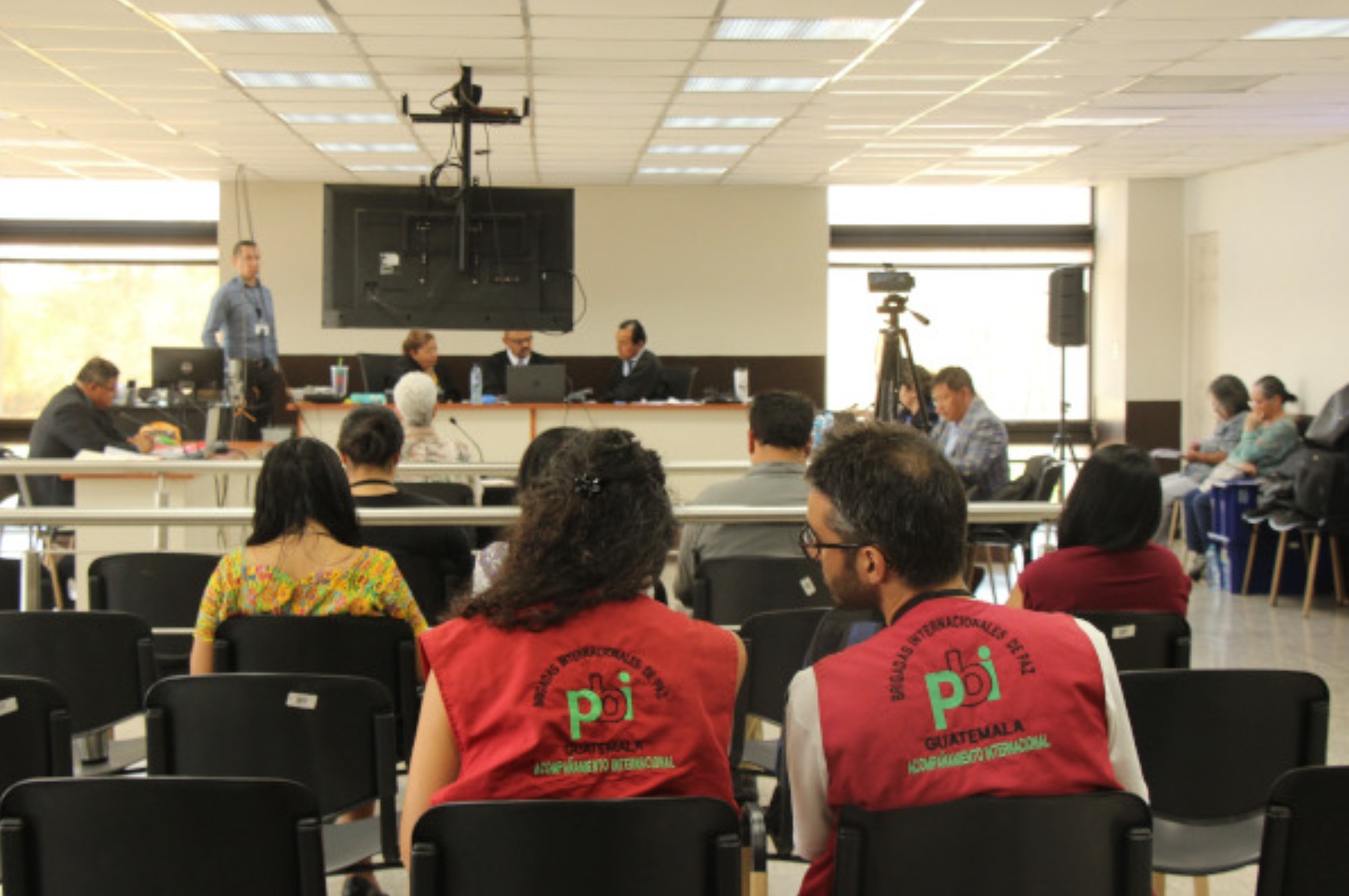
The Peace Brigades International-Guatemala Project has posted on social media:
“This week, #PBI is accompanying Marta and Mirtala Hernández Agustín to the hearings regarding the investigation into the forced disappearance of their sister #LuzLeticia on November 22, 1982. Among other evidence, an expert report was presented on documents found in the National Police Historical Archive that revealed police actions linked to the events.
To learn more about the case and the sisters’ struggle, we invite you to read: https://shorturl.at/pP93Y.”
That link leads to this PBI-Guatemala article (reposted below in full).
But first we highlight this one excerpt: “Doña Valentina participated in the formation of the Mutual Support Group (GAM), joining her efforts with those of other families in the same situation. It was at that time that the Hernández Agustín family came into contact with Peace Brigades International (PBI), which at that time accompanied the GAM, and which, already in 1984/85, accompanied one of the Hernández Agustín sisters who finally had to go into exile in Canada. Currently, PBI continues to accompany Valentina, Marta and Mirtala, Luz Leticia’s mother and sisters.”
40 years searching for Luz Leticia

“The truth must come to light so that history does not repeat itself”1
Luz Leticia Hernández Agustín was captured and disappeared by state security forces on November 22, 1982, at the age of 25. It is feared that she was a victim of torture and extrajudicial execution for collaborating in the kidnapping of Jorge Mario Ríos Muñoz, nephew of the de facto Head of State at the time, Efraín Ríos Montt. The objective was to exchange Ríos Muñoz for a colleague who had been disappeared the previous month.
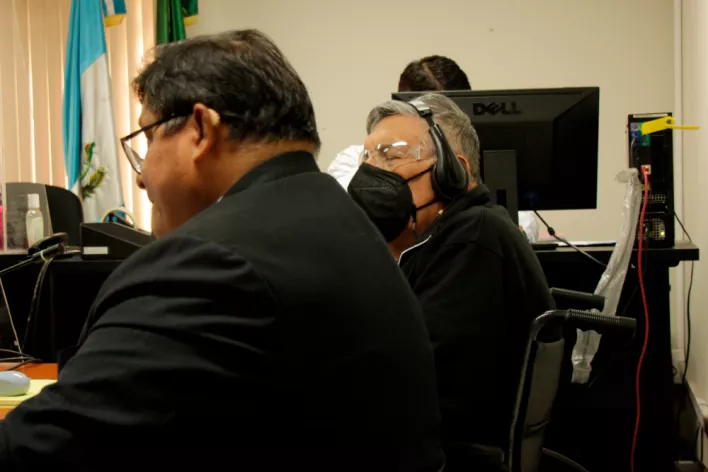
Luz Leticia’s family has not stopped looking for her since then, traveling a long and arduous road in favor of justice. In January 2023, after more than 40 years of tireless struggle, a judicial process was opened on this case. One of the main perpetrators, the former commander of the Special Operations and Reactions Battalion (BROE), Juan Francisco Cifuentes Cano, who was arrested on May 21, 2021 for the Diario Militar case, has been linked to proceedings for forced disappearance and crimes against humanity.
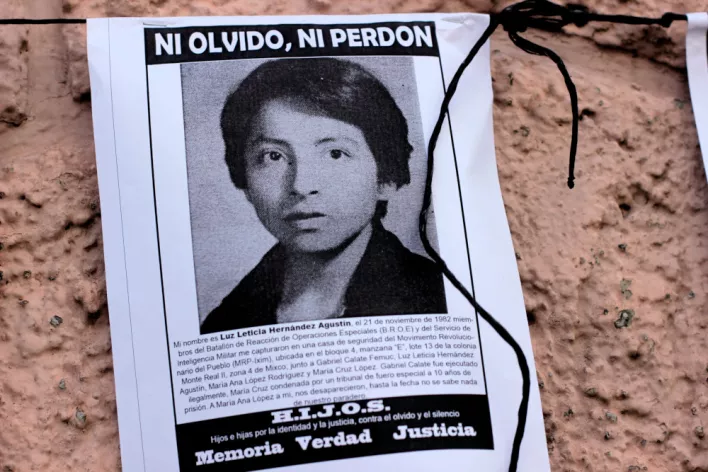
Background
The events occurred during the bloodiest years of the Internal Armed Conflict (CAI) that devastated Guatemala between 1960 and 1996. The CAI began to take shape as a result of the coup d’état perpetrated against the democratic government of Jacobo Arbenz, which ended the decade known as the Democratic Spring (1944-1954), returning to dictatorial regimes. Faced with this closure of spaces, numerous popular and insurgent movements began to develop throughout the country that sought to reverse the political and social conditions of oppression and poverty in which the country was immersed.
The bloodiest stage of the CAI was marked by numerous crimes against humanity committed by several military governments. As pointed out by the Historical Clarification Commission (CEH), the government of Efraín Ríos Montt (1982-1983), which is part of this stage, “gave continuity and expanded the scorched earth policy designed and implemented by his predecessor Romeo Lucas García (1978-1982).
Ostensibly established to destroy insurgent movements, such repressive policies were nevertheless systematically used to destroy social movements that advocated for change and challenged military dictatorships (…). The scant 17 months in which Ríos Montt presided over Guatemala were the most brutal of the conflict. Human rights organizations estimate that 10,000 people were killed in the first three months of his government. During the first eight months of his term, 10 massacres were recorded every month. More than 400 indigenous communities were destroyed. Survivors and relatives of these crimes, as well as human rights organizations, have been fighting tirelessly for decades for justice to be done, the only way to reparation and not repetition of such atrocities.
Luz Leticia’s childhood and youth
Luz Leticia was born on November 22, 1957 into a humble family. She was the eldest of six brothers and sisters who, along with her mother, Valentina Agustín, and her father, Jorge Hernández, grew up in a house near the train tracks, between zones 12 and 13 of Guatemala City, in the La Reformita neighborhood.
Doña Valentina and Don Jorge, both of peasant origin, worked very hard to be able to get their family ahead. He died in 2021 at the age of 88. Since he was a child he worked as a young settler on a farm in Colomba Costa Cuca. According to his daughters Marta and Mirtala, he never forgot his origins and instilled in them values based on humility and mutual respect. He also transmitted to them a way of seeing the world in connection with nature. Doña Valentina was born in Huehuetenango, in the bosom of a Mam family with strong Catholic convictions. She instilled in her daughters a firm belief in peace, love, the need to share and not to do to others what you do not want for yourself. All this marked the path for them to follow.
Despite the extreme poverty in which the family lived, Luz Leticia’s sisters say that, during those years, they were never aware of it, because they grew up surrounded by fruit trees, vegetables, flowers and some domestic animals that formed, together with Don Jorge’s radiotechnics work, the basis of subsistence for the family and a source of joy for the little ones. In addition, they emphasize that the affection and care with which their parents always treated them, made their childhood always full of love. In the words of Mirtala, the youngest of the sisters, “materially we did not have, but the love of home was everything”.
Luz Leticia was the oldest and had an important role in the care of her sisters and brothers. Mirtala remembers her as a very loving and hardworking person, who was always there to accompany and support her. In the same way, she treasured deep values of justice that always accompanied her. For Mirtala, Luz Leticia was and is a source of inspiration, a heroine.
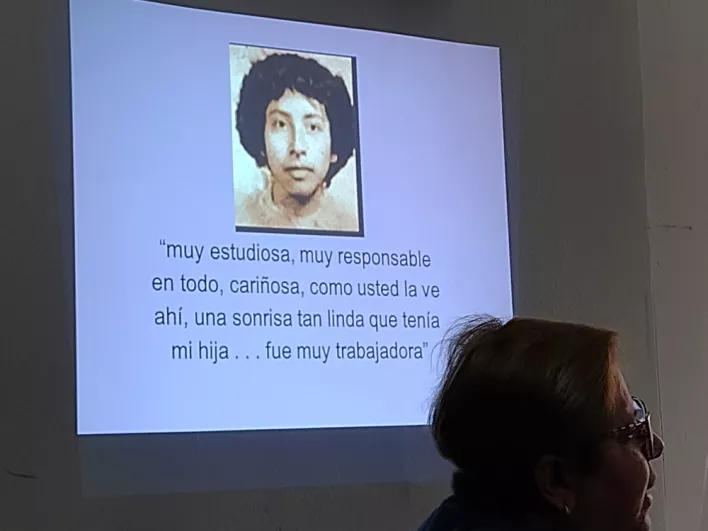
Luz Leticia began her secondary studies at the Belén Institute in 1971. Later, in 1974, she entered the National Central School of Commercial Sciences, where he studied Expert Accounting. When she finished, in 1976, she entered the Faculty of Economics of the University of San Carlos (USAC). During those years, she also worked at the “El Mar” Warehouse, located on Sixth Avenue in Zone 1, to be able to pay for her studies. Her sisters remember that Luz Leticia dreamed of being an economist to contribute to the family economy and the progress of the Guatemalan people.
As Mirtala recalls, her sister Luz Leticia was full of strength and desire to live. She dreamed and believed in a different Guatemala, in democracy and freedom.
Luz Leticia joins “Our Movement”
In 1980, Luz Leticia told her family that she was going to leave her job to set up an accounting firm with other people. Among them was her friend Ileana del Rosario Solares Castillo, who sometimes visited the family home. However, that new project in which Luz Leticia embarked was actually “Our Movement”, an urban insurgency group detached from the Organization of the People in Arms (ORPA). During those years, the student movement was strong and organized. Many young people joined him.
From then on, Luz Leticia remained more distant from family life. Mirtala remembers that her sister suffered a noticeable physical deterioration, she was extremely thin and seemed very tired. Even so, she continued to visit his family sporadically. One of the last times Mirtala remembers seeing her sister was an occasion when she invited her to eat cake at a bakery in the center. Mirtala was 16 years old. They never saw her again.
Arrest and disappearance
On September 25, 1982, state actors kidnapped the militant Ileana del Rosario Solares Castillo. According to the documents of the Historical Archive of the National Police (AHPN), from “Our Movement”, the decision was made to carry out the kidnapping of Mario Ríos, to exchange his freedom for that of Ileana. This kidnapping took place on October 13, 1982 and lasted until November 21 of the same year. The house that was used to hide him was located in the Monterreal neighborhood, in Guatemala City, and Luz Leticia collaborated by pretending to live there with her partner. Between November 21 and 22, a police rescue operation was carried out that culminated in the discovery of the dictator’s nephew and the disappearance of Luz Leticia and her partner Ana Maria López Rodríguez. At first, the operation went to the Melgar Díaz neighborhood, where they arrested 14 people, 9 of them minors. Subsequently, the agents under the orders of Cifuentes Cano, went to the Monterreal neighborhood where Luz Leticia, Ana María, María Cruz López Rodríguez and Leandro Gabriel Calate Temu were arrested.
As it was a case related to the family of the Head of State, it became public and quite mediatic. In December of the same year, María Cruz López Rodríguez and Leandro Gabriel Calate Temu were consigned to the Special Jurisdiction Courts. Leandro was killed during a transfer and, although the autopsy showed signs of torture, the official version maintained that he died of a gunshot during an escape attempt. María Cruz was sentenced to 30 years in prison. Later, during the government of Oscar Humberto Mejía Víctores (1983-1986), she was amnestied. He died in 2002. During those years she wrote a manuscript in which she acknowledged that on the day of her arrest, in addition to Leandro, two more women were arrested, her own sister, Ana María, and Luz Leticia. They were incorporated into the clandestine detention system, thus violating their right to a fair trial, dignified treatment and life, as Luz Leticia’s mother and sisters point out. There is numerous testimonial and documentary evidence that points to the fact that they were retained in the tunnels that are under the old polytechnic school. Nothing was ever heard from his whereabouts again.
During those days, the country’s press reported the finding and rescue of Río Montt’s nephew, however, the Hernández Agustín family did not know that this event affected them directly until approximately November 26, 1982. That day a man visited Don Jorge. He was a tall individual, very well dressed and armed. He told her that his daughter had been captured and insisted that they should demonstrate in front of the presidential house to demand her release. This terrible news marked a before and after in the family’s life. A week later, Gustavo Morataya Hernández, Luz Leticia’s partner, confirmed her arrest and disappearance.
From that moment on, the Hernández Agustín family began a search that has never ceased. For years they filed writs of habeas corpus before the Supreme Court of Justice (CSJ), visited prisons and hospitals, demanded before different competent state bodies that investigations be initiated to clarify the facts, and even went to the Inter-American Commission on Human Rights (IACHR). In 2001, the Court concluded that the State of Guatemala had violated the right to life, humane treatment, personal liberty, a fair trial, and judicial protection of Luz Leticia, Ana María, and Ileana.
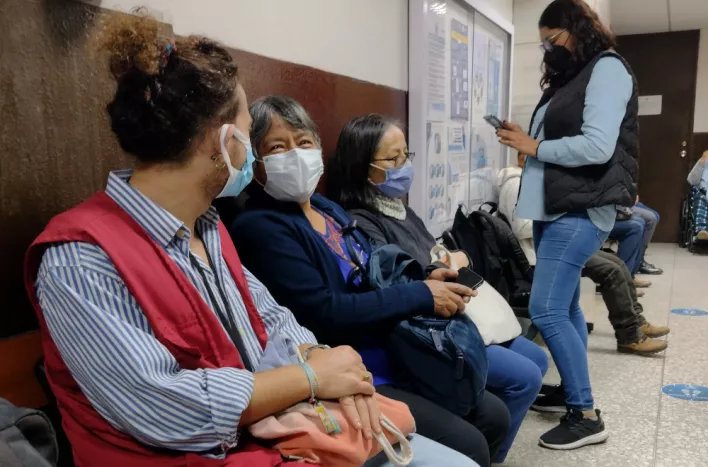
Doña Valentina participated in the formation of the Mutual Support Group (GAM), joining her efforts with those of other families in the same situation. It was at that time that the Hernández Agustín family came into contact with Peace Brigades International (PBI), which at that time accompanied the GAM, and which, already in 1984/85, accompanied one of the Hernández Agustín sisters who finally had to go into exile in Canada. Currently, PBI continues to accompany Valentina, Marta and Mirtala, Luz Leticia’s mother and sisters.
One more step towards the truth
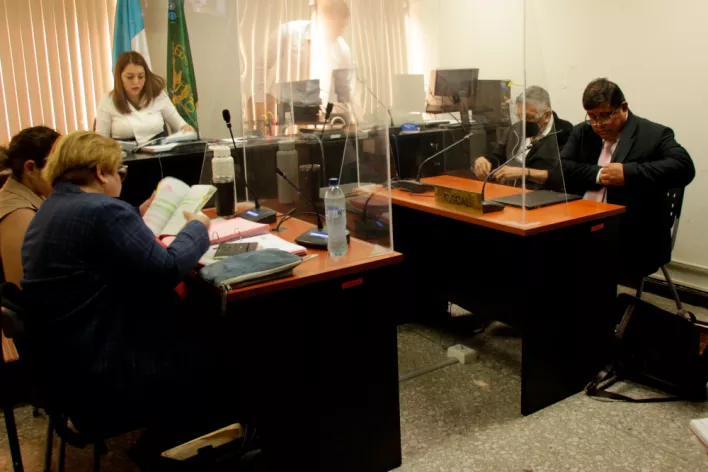
On January 20, 2023, more than 40 years after the disappearance of Luz Leticia, the hearing of Juan Francisco Cifuentes Cano’s first statement took place in the 5th Criminal Court of First Instance of Guatemala City. Doña Valentina was especially excited “to see a light in the search for justice for her first daughter.”
Undue delays in the process have occurred over the years, violating the rights of the family. In fact, the hearing cited above was rescheduled up to eight times for various reasons that according to the family seem to act as an excuse and strategy of attrition. In the last hearing of the first statement, Cifuentes Cano was linked to the process for the crimes of forced disappearance of Ana María and Luz Leticia and for crimes of duties against humanity. The intervention of the legal representation of the Hernández Agustín family gave the case a special gender focus, highlighting the use of gender and sexual violence as tools of torture2.
The case was opened thanks to the family’s enormous efforts to find justice and bring to light the truth about what happened. “The disappearance of our sister deeply hurt the family and in order to heal we need to recover the remains of Luz Leticia and that her murderers face justice once and for all,” says Marta.
In 2006, the State of Guatemala offered them a friendly settlement agreement that they rejected because, as they say, “we do all this to bring to light the truth that our sister lived. But not only for that, for us it is an act of justice that should flood with hope the hearts of the families, who, like us, have lost loved ones unjustly, inside and outside Guatemala. Because silence is one of the greatest accomplices of murderers. Because the truth must come to light so that history does not repeat itself. For them, here and there. For justice.”
1All the information contained in this article and which has no other source, was extracted from an interview conducted by PBI with the sisters (Marta and Mirtala) and the mother (Valentina) of Luz Leticia.
2In its report Guatemala, Memory of Silence, the Commission for Historical Clarification (CEH) points out that “the rape of women, during their torture or before they were murdered, was a common practice aimed at destroying the dignity of the person in one of its most intimate and vulnerable aspects.”

