

The Peace Brigades International-Honduras Project has posted on social media:
“‘The INA [National Agricultural Institute] has restricted and withdrawn its technical support from the Agrarian Platform,’ claims Yoni Rivas, the organization’s spokesperson, who also warns of a failure to comply with the state agreements signed in 2022 to make progress towards resolving the agrarian conflict in Bajo Aguán.
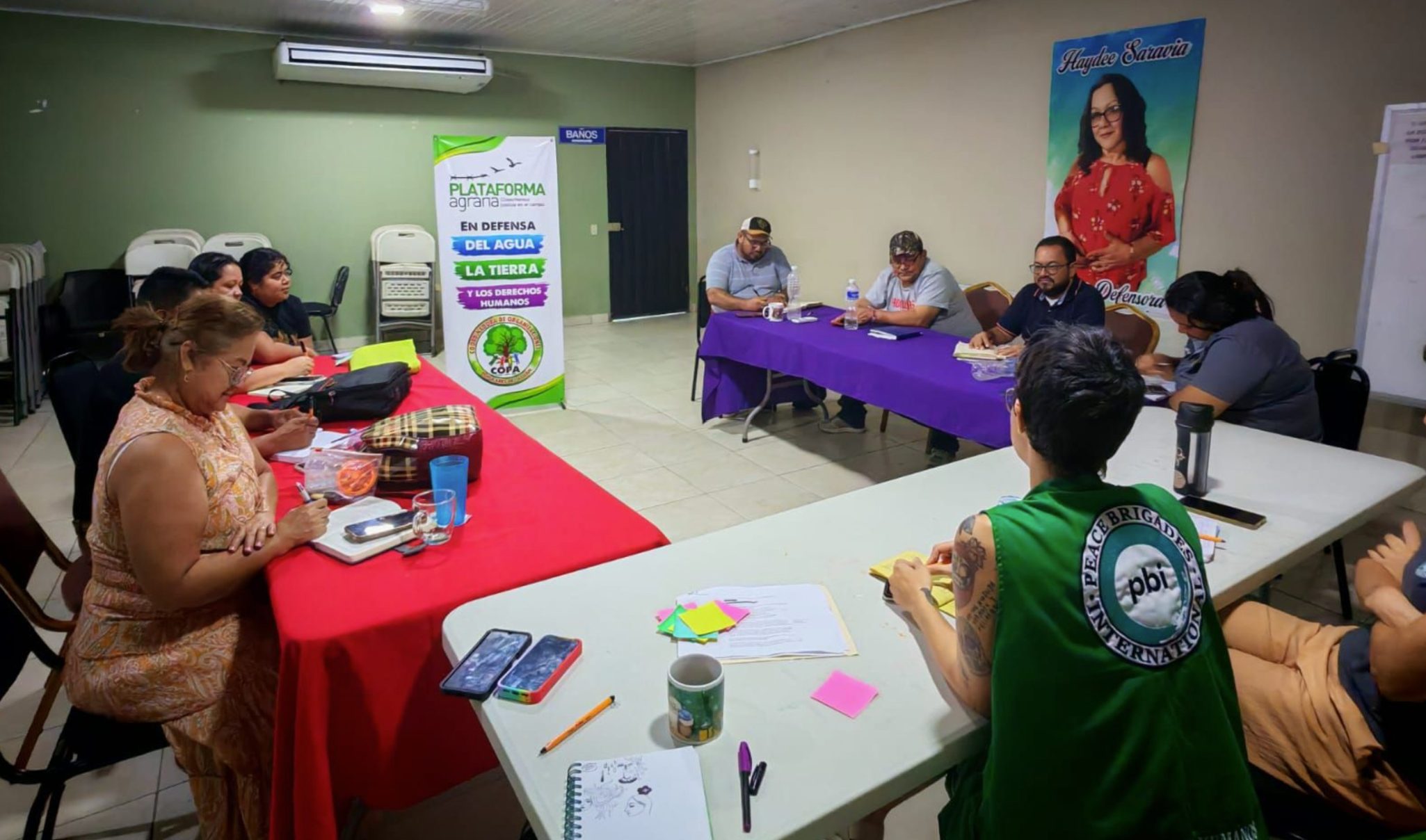
In a meeting with PBI, members of the Agrarian Platform and the Coordinating Committee of Popular Organisations of Aguán (COPA) have expressed their rejection of narratives targeting peasant and indigenous groups.
PBI expresses its concern regarding the violence faced by the peasantry and the growing hate speech directed at human rights defenders.”

Additional context
Avispa Midia has explained: “The Agrarian Platform of Aguán is made up of 25 cooperatives seeking to recuperate their lands in the valley. In addition, there are associate campesino companies, which total 43 organizations, that seek through different forms of struggle to recuperate the lands that were taken from them.”
The Agrarian Platform has previously stated: “For decades, armed groups paid by agro-industrialists have displaced agrarian reform cooperatives, accompanied by disinformation campaigns that present the facts as simple confrontations between peasants.”
In June 2025, Criterio.hn reported: “Yoni Rivas insisted that the authorities must intervene urgently to stop the violence and prevent more deaths [of peasant farmers], denouncing that many of these criminal structures enjoy protection from agro-industrial sectors, especially the Dinant Corporation. … The Agrarian Platform pointed out that there is concern about the participation of palm fruit buyers, authorized by agro-industrial companies, in the promotion of these confrontations, a pattern that has been repeatedly observed in the region.”
Dialogue Earth has previously explained: “The Honduran government started promoting oil palm cultivation during the 1960s [but] it was really in the late 1990s that production skyrocketed [and by July 2023, when the article was published] the country has roughly 200,000 hectares of oil palm yielding close to 600,000 metric tonnes of oil a year.”
Dinant and palm oil exports
That Dialogue Earth article adds: “Of the total national production, 61% comes from just three companies – Corporación Dinant, Grupo Jaremar and Aceydesa – and their plantations are located where the highest levels of violence have been recorded.”
Dinant is a Honduran, family owned company. In 1992 the company started to enter the business into the Aguan Valley.
Mongabay has reported: “In 2009, Dinant benefited from a $30 million dollar loan to develop its plantations from the World Bank’s International Finance Corporation, even though the company was linked to waves of violence against land defenders in the Bajo Aguán Valley region of Honduras.”
That Mongabay article adds: “In 2009, farmer groups warned the IFC that a military coup that summer — carried out with the backing of Dinant’s CEO, right-wing business magnate Miguel Facussé, and unleashing a wave of criminal violence that made Honduras more violent than some war zones — meant the investment was high-risk.”
In November 2023, The Guardian further noted: “In Honduras, [palm oil exports are] mostly going to the Netherlands, the US, Italy and Switzerland, with a value of $334m in 2021. Six large companies control the production, and two claim more than half of all exports.”
It appears that Canada also imports some amount of palm oil from Honduras. We will be in contact with the Trade Commissioner Service of Canada for additional information.
Accompaniment
On October 30, 2024, PBI-Honduras facilitated a visit for PBI-Canada with COPA representatives including Yoni Rivas, Raul Ramirez and Wendy Castro.
There was an armed attack in December 2025 that injured Castro, the Deputy Coordinator of the Platform.

We continue to follow this.

