


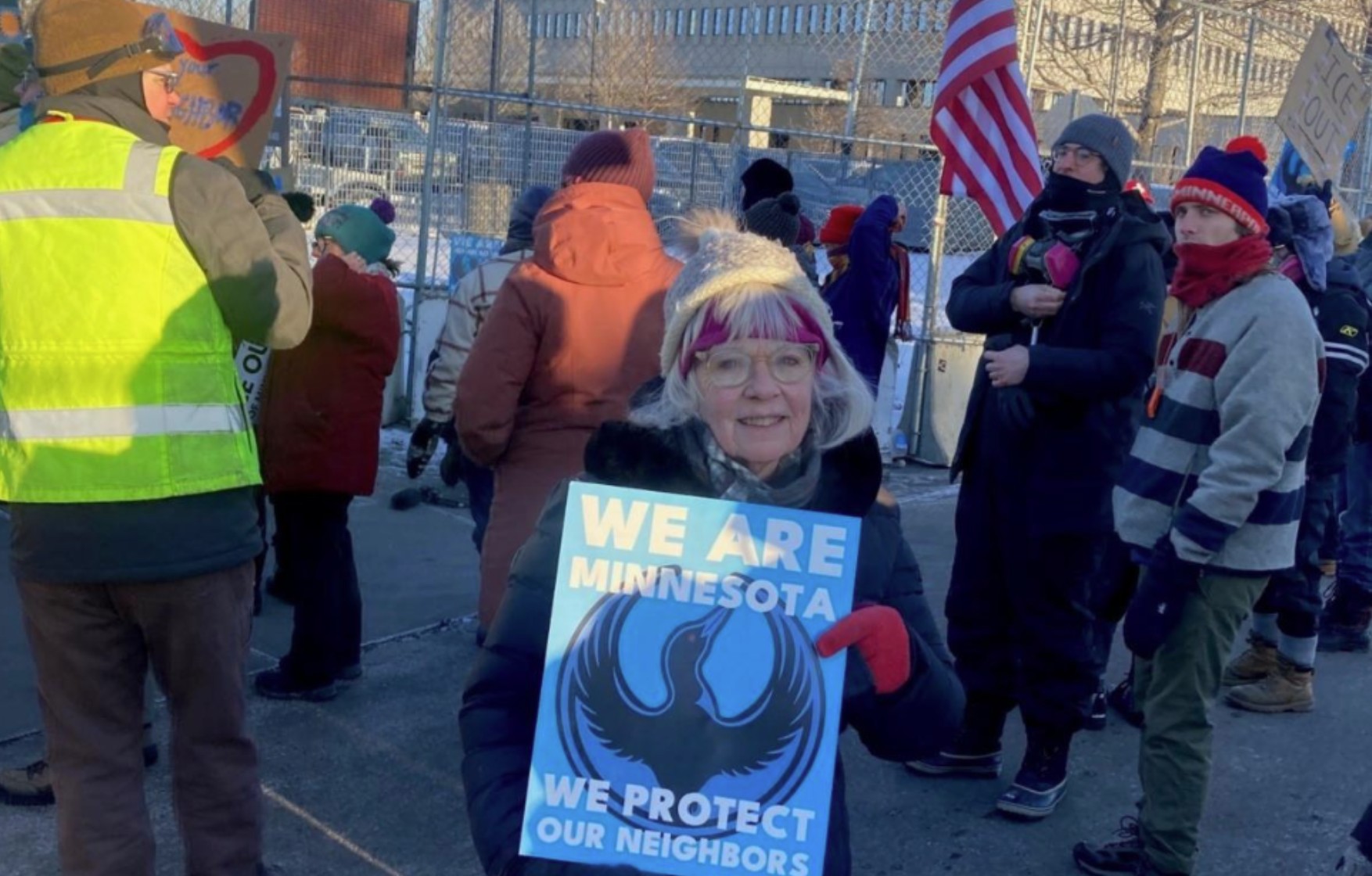
Photo: Becky Flory, a member of the Twin Cities Friends Meeting and a longtime volunteer with AFSC, joined 1,000 people of faith last month at the Minneapolis-St. Paul International Airport to protest ICE deportation flights.
Jon Krieg, a regional communications specialist for the American Friends Service Committee (AFSC), writes: “Quakers believe in the inherent dignity of all people. But how do we live our beliefs in times of such brutal and sometimes deadly enforcement of cruel immigration policies?”
Krieg notes: “In Twin Cities, Minnesota, Quakers—alongside partners in the faith community—have refused to accept violence against immigrants in their communities. On Jan. 23, over 1,000 people of faith, led by the nonprofit group ISAIAH, held a nonviolent action at the Minneapolis-St. Paul International Airport. They were protesting ICE deportation flights—part of a wider response to the Trump administration’s attacks on immigrant communities.”
He further highlights: “In a recent letter to Northern Yearly Meeting, Stephen Snyder, clerk of Minneapolis Friends Meeting, writes: ‘Many Friends participate in organized networks such as the Immigrant Defense Network and Faith in Minnesota that train citizens in non-violent resistance and support for migrant communities. Others host refugees, volunteer in the schools, contribute to food banks, and serve in other ways.’”
AFSC supports call to halt funding to ICE
On January 27, 2026, the American Friends Service Committee along with 1,025 organizations signed a joint letter to the US Congress to express their “horror, outrage and deep grief about the news that federal agents have executed [Alex Pretti] in broad daylight on the streets of Minneapolis.”
That letter demanded: “Congress must refuse to provide one dollar to Immigrations and Customs Enforcement (ICE) or Customs and Border Protection (CBP) Border Patrol through the appropriations process and immediately take action to revoke the tens of billions already given through last summer’s reconciliation bill.”
ICE deploys armoured vehicles made by Ontario company
Just weeks prior to that AFSC call for a funding freeze, ICE signed a contract for about CAD $10 million with an Ontario company.
On December 2, 2025, the Canadian Press reported: “U.S. Immigration and Customs Enforcement earmarked millions of dollars for a bulk order for 20 armoured vehicles from Canadian defence manufacturer Roshel… The justification for the sole-source order was published in a partially redacted document on a U.S. federal procurement website on Nov. 26, and the site says a contract was awarded on Nov. 28.”
It was just a few days later, on December 1, 2025, that the Department of Homeland Security (DHS) announced Operation Metro Surge in Minnesota.
Then on January 6, 2026, the DHS announced this operation would send as many as 2,000 agents to the area.
If the contract was awarded to Roshel by the Department of Homeland Security on November 28, 2025, and the order was to be completed within 30 days, that would put the delivery date around December 26-27, 2025.
On January 28, 2026, the Canadian Press reported: “Asked what he makes of criticism of Canadian companies providing vehicles and other infrastructure to ICE, Public Safety Minister Gary Anandasangaree said Tuesday [January 27] that he would ‘let the respective Canadian companies answer that question’.”
US, Roshel at CANSEC
In June 2025, under the Trump Administration, the United States Embassy in Ottawa posted on Instagram: “Deputy Chief of Mission Marybeth Turner led the U.S. delegation to #CANSEC, Canada’s top defense, security, and emerging technology event.”
It is possible that the Department of Homeland Security (DHS) and Immigration and Customs Enforcement (ICE) could also participate in some way.
Roshel is both a sponsor and an exhibitor at CANSEC.
PBI-Canada continues to highlight the relationship between the export of “military goods”, arms and technology and the impact those have on organizations, social movements, human rights defenders and communities.

