


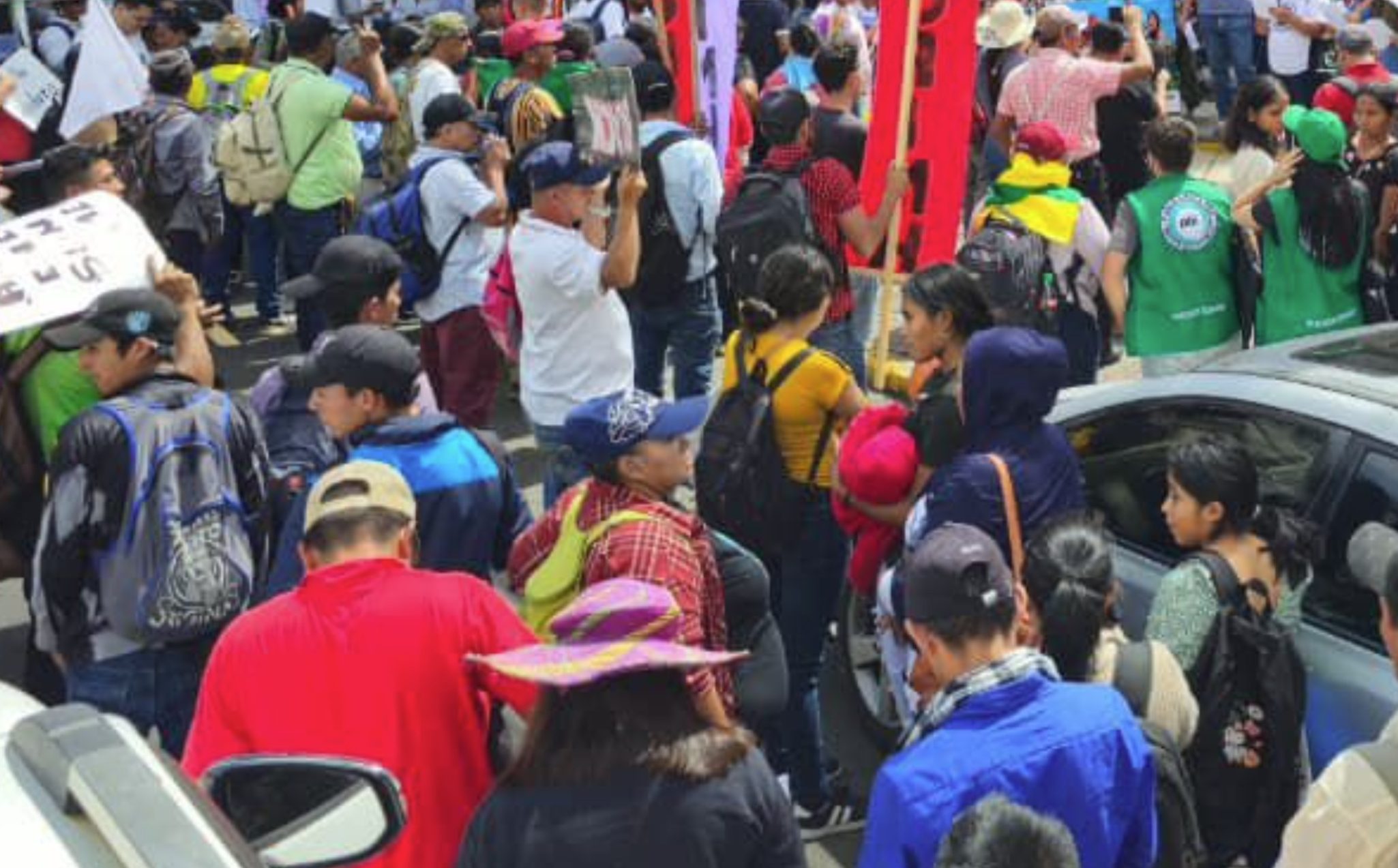
Photo by Plataforma Agraria.
The Peace Brigades International-Honduras Project has posted on social media:
“Under the slogan ‘Land is not for sale; it must be protected and defended’, a peaceful demonstration took place to mark International Day of Peasants’ Struggles, which is celebrated every April 17. During the march, the organizations and groups united within the Honduran Peasant, Indigenous and Popular Alliance reaffirmed the ongoing struggle for land, food sovereignty and the dignity of those who sustain life from the countryside.”

In their Facebook post, PBI-Honduras tagged the National Union of Rural Workers (CNTC), the Council of Popular and Indigenous Organizations of Honduras (COPINH) and Plataforma Agraria, a national network of more than 30 organizations that promotes agrarian reform and policies in favour of peasants.

Criterio.hn reports: “More than three hundred people from the agrarian movement arrived in the Honduran capital on the International Day of Peasant Struggles to demand access to land, comprehensive agrarian reform and an end to evictions and criminalization. …Brought together in the Peasant, Indigenous and Popular Alliance of Honduras, more than 30 grassroots organizations demanded social justice and access to land and denounced the persistence of deep inequalities in the countryside, the concentration of land and the historical exclusion of communities from the interests of agribusiness.”
The article highlights: “The mobilization occurs while the administration of [Honduran president] Nasry Asfura analyzes actions to strengthen the ‘legal security’ of agribusiness in land conflicts, a point that peasant organizations question for its impact on communities.”
It adds: “Along these lines, Pedro Mejía, a lawyer for the Agrarian Platform, indicated that the possible toughening of the crime of usurpation and the relaxation of evictions would intensify the criminalization of the peasant and indigenous movement, as they are used as tools to intimidate, prosecute and dispossess communities of land.”

Prensa Rural adds: “During this day of protests, which began on April 16 in Tegucigalpa, the National Police arrested peasant leader José Luis Fuentes, an incident that has caused alarm among social organisations. Fuentes, a member of the Landless Movement in El Progreso, Yoro, was detained at the El Durazno police post, at the entrance to the Central District, whilst on his way to take part in the protest actions organized as part of this commemoration. The arrest comes at a time that organizations describe as a resurgence in the criminalization of peasant leaders.”
Canada and UN vote on peasant rights
At this time, we recall that Canada abstained in the vote on the United Nations Declaration on the Rights of Peasants and other people working in rural areas that was adopted by the UN General Assembly in December 2018.
PBI-Honduras has previously noted that this UN Declaration recognizes key elements such as “the right to land, to natural resources and to food sovereignty, based on the principle of equality between men and women.”
Image showing Canada’s vote on the UN Declaration shared by Andrea Nuila, gender and women’s rights coordinator at FIAN International, at a PBI co-organized webinar.

We continue to follow this.


