


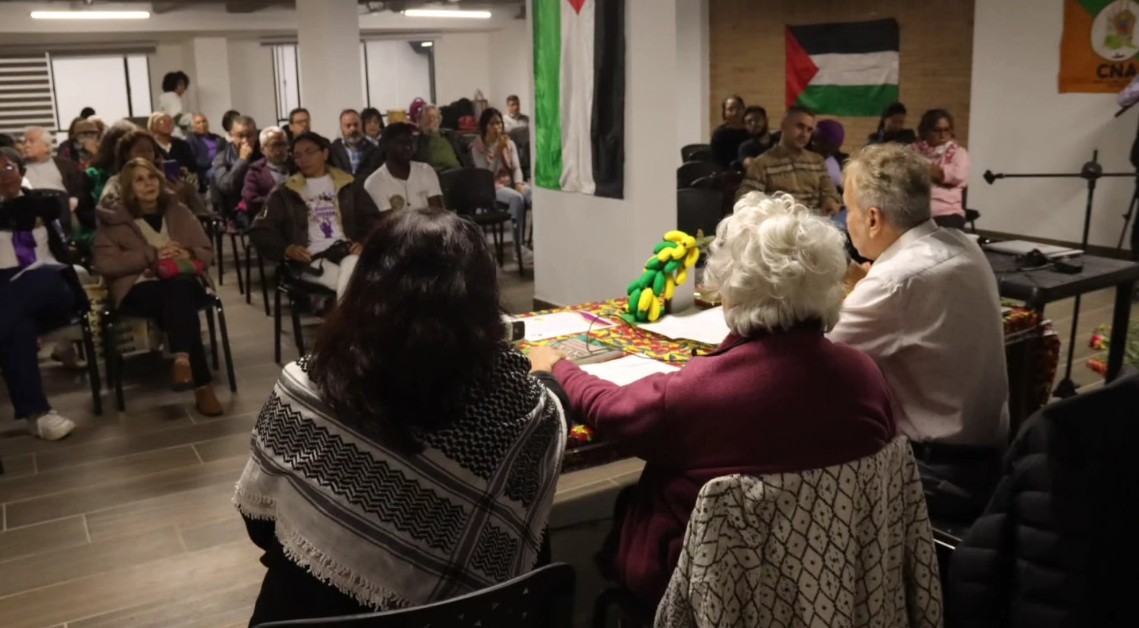
The Association for Social Research and Action (Nomadesc) has posted on social media:
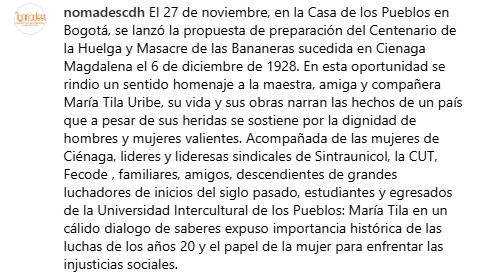
“On November 27th, at the Casa de los Pueblos (House of the Peoples) in Bogotá, the proposal for the Centennial of the Banana Strike and Massacre, which took place in Ciénaga, Magdalena, on December 6, 1928, was launched. On this occasion, a heartfelt tribute was paid to the teacher, friend, and colleague María Tila Uribe. Her life and work narrate the events of a country that, despite its wounds, endures thanks to the dignity of courageous men and women. Accompanied by the women of Ciénaga, union leaders from Sintraunicol [the National Union of University Workers and Employees of Colombia], the CUT [the Central Union of Workers], and Fecode [the Colombian Federation of Education Workers], family, friends, descendants of great fighters from the beginning of the last century, and students and graduates of the Intercultural University of the Peoples, María Tila, in a warm exchange of knowledge, spoke about the historical importance of the struggles of the 1920s and the role of women in confronting social injustices.”
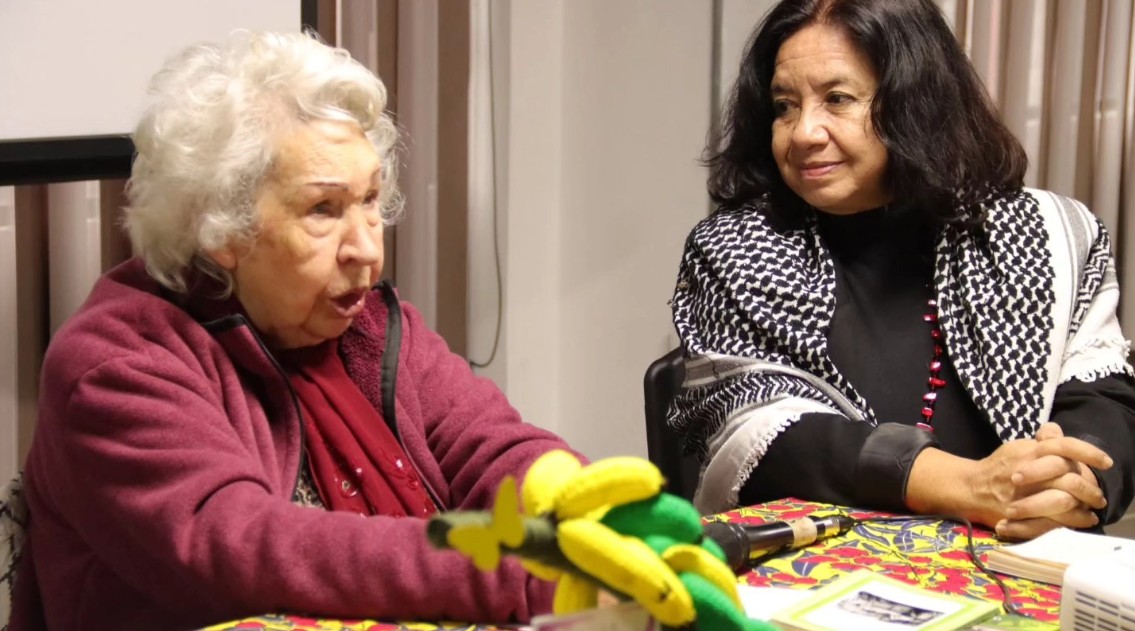
Center of Labor Studies and Research (Cestra) has noted: “Tila Uribe began teaching basic literacy at the beginning of the 1960s. Accused of subversion, she remained in prison for four years. After her liberation, she took her teaching experience to Nicaragua, invited by the Sandinista government.”
That article adds: “In 1985, she founded, in Bogota, the Centre of Labor Studies and Research (Cestra). It promotes the education of trade union members and rural workers focusing particularly on the elderly. …[In 2010] she took on the post of Head of the History department at the National School for Female Leaders of Trade Unions.”
Commemoration in 2028 of the Banana Massacre
This past September, a letter signed by Nomadesc highlighted: “In 2028, the centenary of the massacre against the workers who worked for the United Fruit Company, murdered on December 5, 1928, is commemorated. The undersigned organizations are coordinating the great pilgrimage in honor of the heroes of the banana strike…”
Time magazine has provided this history of the Banana Massacre:
“In October 1928, banana workers from UFC plantations in the Magdalena zone assembled and created a list of [nine] demands under the labor union Magdalena Workers Union (Unión Sindical de Trabajadores del Magdalena, USTM). Their demands were modest, ranging from higher pay and insurance to the discontinuance of company stores. The most important demand, however, was the recognition of UFC employees as formal company workers entitled to the full protections of Colombian labor law.
United Fruit’s general manager, Thomas Bradshaw, baulked. He refused to recognize and negotiate with the USTM.
In a final effort [after failed negotiations], crowds of workers gathered at Ciénaga to talk with the governor and United Fruit. Neither the governor nor a UFC representative ever arrived, but by nightfall, General Carlos Cortés Vargas, now armed with a new decree to restore order, demanded the crowd disperse and return home. When workers refused, the general’s soldiers lit the plaza up with gunfire.”
As many as 2,000 workers were killed that night.
The University of Toronto Visualizing the Americas project notes: “The people of the banana zone insisted that the military killed hundreds of strikers that night, but when daylight broke, according to official memory, just nine bodies lay in the plaza. Josefa María, who worked from Ciénaga to support the strike, noted that the military had deliberately left each corpse as a symbol: ‘They had only left nine dead bodies, equal to the nine demands that the workers made.’”
In 1970, the United Fruit Company merged with another company to form the United Brands Company.
In 1990, that company was renamed Chiquita Brands International.
Accompaniment
Peace Brigades International has accompanied the Association for Social Research and Action (Nomadesc) since 2011, and its president Berenice Celeita since 1999.

