

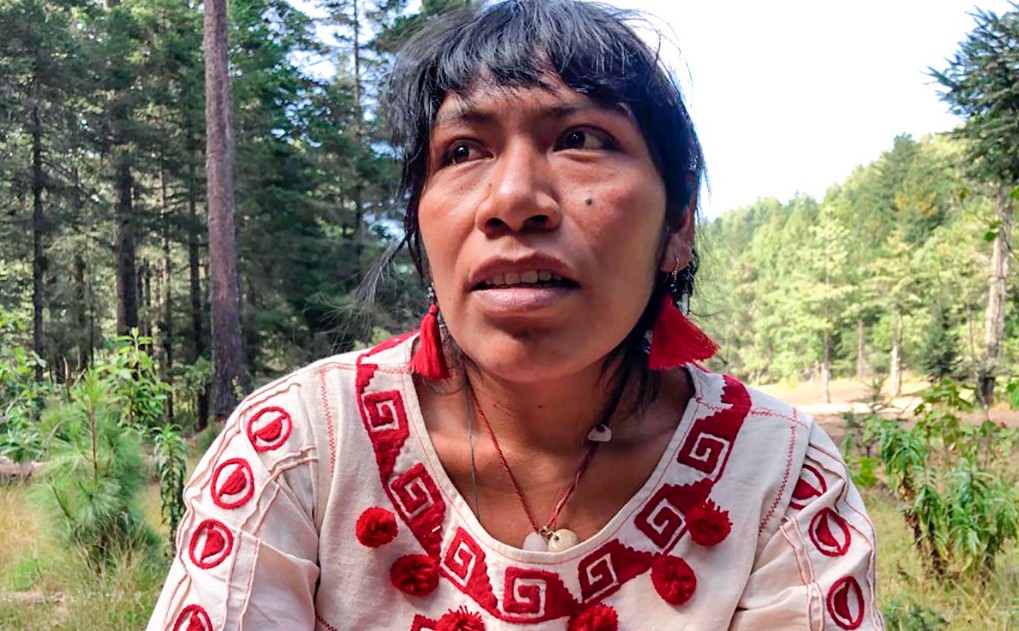
Photo: Irma Galindo Barrios, a 41-year-old member of the Indigenous Mixtec people, was forcibly disappeared on October 27, 2021, as she worked to protect the communal Ñuu Savi Forest from logging.
BNN Bloomberg reports: “Prime Minister Mark Carney is expected to sign a strategic partnership agreement with Mexican President Claudia Sheinbaum during his visit to Mexico, which starts today. The agreement will cover infrastructure, trade, health, agriculture, emergency preparedness and security, senior government officials say.”
CBC News adds: “The trip is expected to produce an agreement on a new Canada-Mexico comprehensive partnership and a security dialogue focused on issues such as transnational crime and drug-smuggling.”
The following week, two Mexican human rights defenders will be in Ottawa to meet with Global Affairs Canada officials, Members of Parliament, and others to highlight the security situation faced by human rights defenders and journalists.
Photo: Elizabeth Guadalupe Mosqueda Rivera and Héctor Hugo Arreola Galván.

Elizabeth Guadalupe Mosqueda Rivera is with the Consortium for Parliamentary Dialogue and Equity Oaxaca (Consorcio Oaxaca) and Héctor Hugo Arreola Galván is from the Zeferino Ladrillero Human Rights Center (CDHZL).Both Elizabeth and Hugo are members of the Civil Society Space of Organizations for the Protection of Human Rights Defenders and Journalists (Espacio OSC).
110 Indigenous land defenders killed
The latest figures from the Global Witness database indicate that over the 13-year period of 2012 and 2024 at least:
– 222 land and environmental defenders were killed or disappeared in Mexico
– 110 of the 222 defenders killed were Indigenous (in a country where 19% of the population is Indigenous)
– 17 of the 110 Indigenous defenders were killed by the police or private military actors
– 15 of the 110 Indigenous defenders killed were in a struggle related to mining and extractives
– 42 of the 222 defenders killed involved mining and extractives
– 28 of the 222 defenders were killed by the police or private military actors.
The Protection Mechanism
During their visit to Ottawa, Elizabeth and Hugo will highlight concerns about and proposals for the Protection Mechanism for Human Rights Defenders and Journalists.
Mexico first created a Protection Mechanism for journalists in Autumn 2010. Two years later, the Law for the Protection of Human Rights Defenders and Journalists was passed in June 2012. That law obliges both federal and state authorities to protect the rights of journalists and human rights defenders.
The Government of Canada has recently expressed concern about the Protection Mechanism during the United Nations (UN) Universal Periodic Review (UPR) of Mexico and made recommendations for its strengthening.
At the UN UPR session held on January 24, 2024, Canada recommended that Mexico: “Strengthen, from an intersectional and gender perspective, the federal Protection Mechanism for Human Rights Defenders and Journalists, specifically in the areas of prevention, protection, investigation, and reparation.”
Prior to this session, Canada had also asked Mexico: “How will the new General law to respect, protect, guarantee, and promote the rights of human rights defenders and journalists address key challenges under the current mechanism, including in achieving results, improving federal-state-municipal cooperation, and promoting prevention of violence against human rights defenders and journalists?”
“Notable deficiencies” in the Protection Mechanism
Years before the UN UPR, Peace Brigades International (PBI) had commented in March 2020: “the Mechanism continues to demonstrate notable deficiencies and concerning failures.”
The year before that, PBI also highlighted: “The Mechanism can’t possibly address its shortcomings with its current budget and staffing levels. Providing additional funding would be the first step the Mexican government can take to ensure the Mechanism has the resources necessary to manage its rapidly growing caseload.”
Irma Galindo Barrios

Photo: Irma Galindo Barrios
Because of her work protecting communal forests from logging, Mixtec land defender Irma Galindo Barrios had faced “intimidation, harassment, persecution, smear campaigns and death threats” by public officials since 2018.
She had been scheduled to virtually attend a meeting on October 29, 2021, in Mexico City to join the Protection Mechanism for Human Rights Defenders and Journalists.
Despite this history of multiple attacks against Irma, the Protection Mechanism risk analysis had stated her situation was “ordinary”, meaning that “she can wait” and that “her life is not in danger”.
Irma was forcibly disappeared on October 27, 2021, two days before the meeting with Protection Mechanism was to take place.
Peace Brigades International is bringing Hugo and Elizabeth to Ottawa in the hope of addressing this situation for land and environmental defenders, human rights defenders, and journalists who continue to face risks for their work.

