


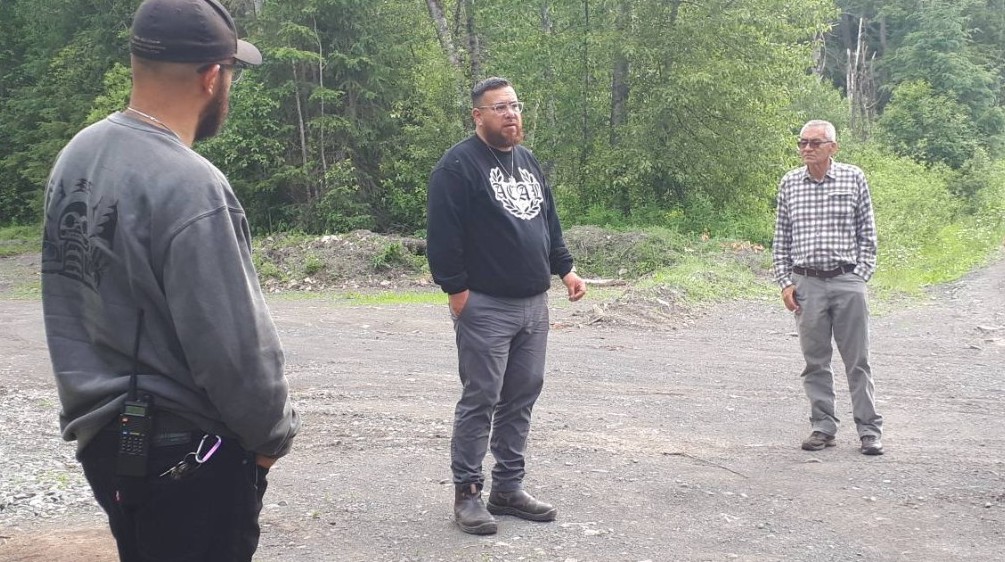
Photo: PBI-Canada and PBI-Colombia visited the emerging frontline resistance to the Prince Rupert Gas Transmission (PRGT) fracked-gas pipeline on Gitxsan and Gitanyow territories in June 2025. Photo by Brent Patterson.
The Guardian reports: “Brazil has issued an urgent call for all countries to come forward with strengthened national plans on the climate, in a last-ditch attempt to meet a key September deadline. Only 28 countries have so far submitted carbon-cutting proposals to the UN, with some of the biggest emitters of greenhouse gases – including China and the EU – still to produce their plans.”
The United Nations registry of countries that have submitted their “nationally determined contributions” can be found here.
The United States
The current situation is not looking promising.
On July 29, 2025, CNN reported: “The Trump administration fired the last of the US climate negotiators earlier this month, helping cement America’s withdrawal from international climate diplomacy. It may also have handed a huge victory to China. … [This] leaves the world’s largest historical polluter with no official presence at one of the most consequential climate summits in a decade: COP30, the annual UN climate talks in Belém, Brazil, in November.”
That article comments: “Experts fear the US absence may derail climate ambition. Wealthy countries, including those in Europe, may use it as a ‘license to backtrack’, said Chiara Martinelli, director of Climate Action Network Europe.”
Canada
The Canadian government of Prime Minister Justin Trudeau submitted its plan in February 2025. Canada’s current prime minister, Mark Carney, was sworn into office in March. By June 26, the Carney government had passed Bill C-5 with the intention of speeding up the approval process for new megaprojects, including pipelines.
Indigenous land defenders have stated the C-5 violates their rights and that there will be resistance to megaprojects that lack their consent.
Palestine
This past May, climate justice reporter Nina Lakhani also highlighted: “A study shared exclusively with the Guardian found the long-term climate cost of destroying, clearing and rebuilding Gaza could top 31m tonnes of carbon dioxide equivalent (tCO2e).”
Lakhani adds: “This is more than the combined 2023 annual greenhouse gases emitted by Costa Rica and Estonia, yet there is no obligation for states to report military emissions to the UN climate body.”
She further notes: “Hamas bunker fuel and rockets account for about 3,000 tonnes of CO2e, the equivalent of just 0.2% of the total direct conflict emissions, while 50% were generated by the supply and use of weapons, tanks and other ordnance by the Israeli military (IDF), the study found.”
Climate summit, September 24
The Guardian now additionally reports: “Brazil has markedly stepped up its diplomatic efforts in the past week, as the prospects for Cop30 look increasingly difficult.”
Next up, the next General Assembly session in New York from September 22-30 will include a “climate summit” on September 24.
The United Nations highlights: “The UN Secretary-General is convening a Climate Summit to serve as a platform for world leaders to present their new national climate action plans… Ahead of COP30 in Brazil, the Summit will focus on demonstrating commitment and accelerating action to protect people and the planet in line with the goals of the Paris Agreement.”
Land and environmental defenders
Last year, Global Witness documented “that 196 defenders were murdered in 2023 after exercising their right to protect their lands and the environment from harm. The actual number is likely to be higher.”
Global Witness estimates that the total number of defenders killed since 2012 now stands at 2,106 murders.
The next Global Witness report that will document attacks and the killings of defenders in 2024 is expected to be released in September.
“Blatant attempts” to eliminate references to defenders
Still, it does not appear that land and environmental defenders will be on the official agenda of COP30. Furthermore, despite the increasing number of environmental defenders killed – at least 1,500 since COP21 in Paris in 2015 – the texts emerging from these summits have failed to both address or even acknowledge this situation.
And it appears that the dynamic is not just that defenders are not mentioned, but rather that any references to them are being removed.
A week into COP29 last year, Camilla Pollera of the Center for International Environmental Law commented: “The blatant attempts to eliminate reference to the protection of environmental human rights defenders and human rights is especially alarming.”
And Floridea Di Como of CambiaMO in Spain added: “To take out from the text reference to Land and Environmental Human Rights defenders is to make a deep injustice from the recognition, procedural and distributive points of view.”
Michel Forst, the UN Special Rapporteur on Environmental Defenders (Aarhus Convention), has also previously commented on a PBI-Canada organized webinar: “There are people who are willing to push for good results and at the same time we know that we also have people who are not our allies who are pushing also for counter-results and trying to delete paragraphs and good wording that some of us, some of them, would like to introduce.”
Declining credibility of COPs
As States push against needed action, the credibility of the COP process declines.
Swedish climate activist Greta Thunberg has described COP26 as a “failure” and a “PR exercise”, declined to attend COP27 calling it a forum for “greenwashing”, and last year tweeted: “As the COP29 climate meeting is reaching its end, it should not come as a surprise that yet another COP is failing.”
This summer, renowned Canadian environmentalist David Suzuki also stated: “We’ve had 28 COP meetings on climate change and we haven’t been able to cap emissions. We’re on our way to more than a three-degree temperature rise by the end of this century, and scientists agree we shouldn’t rise above one and half degrees. …I’m saying, as an environmentalist, we have failed to shift the narrative and we are still caught up in the same legal, economic and political systems.”
Ways forward
With the credibility of the UN COP process in steep decline, the climate crisis worsening, and the situation for land and environmental arguably deteriorating in this context, how do we move forward?
Suzuki has commented: “For me, what we’ve got to do now is hunker down. The units of survival are going to be local communities, so I’m urging local communities to get together.”
It remains to be seen how this context informs the strategies and approaches to protect the lives of land and environmental defenders. But as we continue to support calls for States and businesses to take action, PBI-Canada is also reflecting on community-based strategies for strengthening the safety and security of frontline defenders.
PBI-Turtle Island
In the context of government inaction and the failure of COPs, we recall the Indigenous Resistance Against Carbon report produced by the Indigenous Environmental Network and Oil Change International in August 2021.
That study found that “the work of countless Tribal Nations, Indigenous water protectors, land defenders, pipeline fighters, and many other grassroots formations” to resist numerous extractive megaprojects on Turtle Island “including ongoing struggles, victories against projects never completed, and infrastructure unfortunately in current operation — adds up to 1.8 billion metric tons CO2e, or roughly 28 percent the size of 2019 U.S. and Canadian pollution.”
This is, in part, why PBI-Canada is building on PBI’s accompaniment experience in Latin America to develop a new model of physical accompaniment on Indigenous lands and territories within Canada.
Upcoming webinar
On Tuesday November 18, Peace Brigades International (PBI) is planning to bring together a United Nations Special Rapporteur and PBI accompanied defenders to talk about the risks and protection needs of those on the frontlines challenging the extractive industries that are accelerating the climate crisis.
You can pre-register for this webinar by clicking here.
COP30 takes place from November 10 to 21 in Brazil.
Additional reading:
PBI notes COP30 caravans, assemblies and calls for the protection of environmental defenders (PBI-Canada, March 25, 2025)
COP30 in the Amazon: Crucial summit or climate carnival? (Marcos Colón, El Pais, August 4, 2025).

