


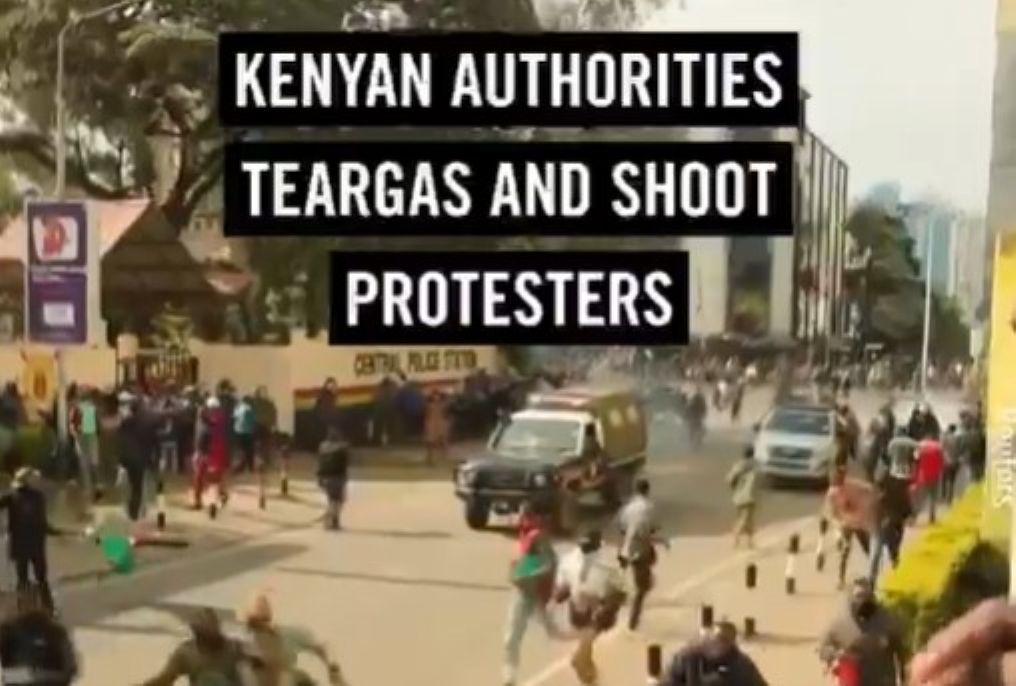
Still from Amnesty International video of police repression of June 25 protests.
On July 7, 2025, the Police Reforms Working Group posted this social media message: “On #SabaSaba2025, Kenyans protested in 20 counties. At least 9 were shot dead, per @HakiKNCHR [the Kenya National Commission on Human Rights]. Police used military-grade weapons, unmarked vehicles and masked officers. Protesters were blocked, brutalized and denied medical aid. #FreeToProtest.”

The Peace Brigades International-Kenya Project is a member of the Police Reforms Working Group. The group is an alliance of national and grassroots organizations committed to professional and rule of law policing.
By July 9, Al Jazeera reported: “The death toll from antigovernment protests in Kenya has surged to at least 31 people, the country’s human rights commission said, with at least 107 others wounded during the nationwide marches.” In their most recent e-newsletter, PBI-Kenya notes that there were 38 fatalities.
June 25 protests
These fatalities followed the deaths at protests two weeks earlier.
On June 26, the Associated Press reported: “The number of Kenyans who died during Wednesday [June 25] nationwide protests over police brutality and bad governance has doubled to 16, according to the state-funded human rights commission. …Many protesters were enraged by the recent death of a blogger in custody and the shooting of a civilian during protests over the blogger’s death.”
Human rights defenders arrested
On June 26, the Kenya Human Rights Commission also posted on Facebook: “We were in court today for the mention of a case against Francis Mutunge, John Mulingwa, and Mark Amiani. The human rights defenders were arrested on June 26, and trumped-up charges of incitement, theft, and malicious damage to property, which they deny, were leveled against them, following the June 25 anniversary protests.”
On July 1, PBI-UK tweeted: As President Ruto visits the UK to discuss the UK-Kenya Strategic Partnership, PBI joins others in raising concern over the arbitrary arrest of social justice HRDs on 26 June. The working environment for defenders in Kenya is worsening, with rising threats & criminalisation.”
UK arms sales to Kenya
The same day as this PBI-UK tweet was posted, Kenyans.co.ke reported: “The Kenyan government has agreed to buy military equipment worth Ksh12.5 billion from the United Kingdom, according to a disclosure from the British government.”
The British government has previously noted that the Kenya government was invited to and in fact attended the Defence and Security Equipment International (DSEI) arms show in London, UK in September 2023.
The next DSEI takes place on September 9-12 of this year.
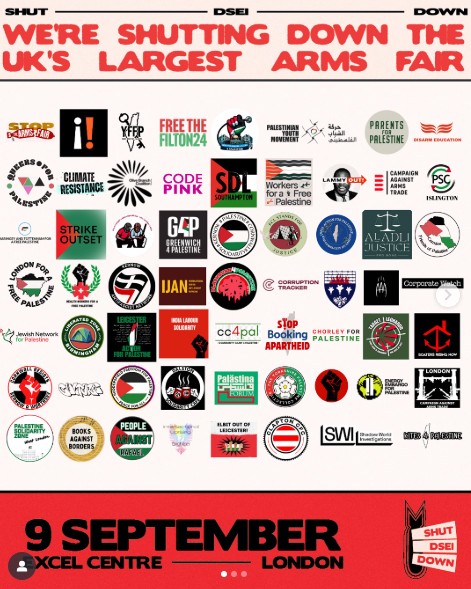
More than 65 groups will be taking action on September to shut down DSEI. They highlight: “This is where war starts. This is where repressive border policies start. This is where torture starts. This is where the contacts are made and the lucrative deals done that fuel genocide, war crimes and human rights abuses around the world.”
Image from Shut DSEI Down on Instagram.
1,500 arrested at July 7 protests in Kenya
The Guardian has also reported that “nearly 1,500 Kenyans [have been] arrested and charged after the nationwide 7 July protests” this year.
This article continues: “Data shared with the Guardian from the Police Reforms Working Group, a civil society coalition focused on strengthening oversight and the rule of law, documents 316 such arrests. The majority are of men below the age of 25. Of the 316, 70% – or 221 of those arrested – have been charged with terrorism, robbery with violence, theft and arson – offences that carry high bail conditions of up to KSh1,000,000 [that converts to more than CAD $10,000.].”
“Lawfare”: new laws constrain the right to protest
The Guardian article further notes: “Mwaura Kabata, vice-president of the Law Society of Kenya, says: ‘This is ‘lawfare’. The government is weaponising existing acts of parliament as well as trying to introduce new ones, such as the assembly and demonstration bill, in order to address both offline and online dissent.’”
In April 2025, Utsav Biswas, a second year student of National Law University Odisha, wrote: “The Kenyan government has passed the ‘Assembly and Demonstration Bill 2024’ where its provisions under the pretence of establishing neutral time/place/manner regulations in forming assemblies and demonstrations effectively impose disproportionate restrictions on the basic freedom of assembly and demonstration, recognised by Article 37 of the Kenyan Constitution.”
And on July 2, 2025, Citizen Digital reported: “The State, through parliament has once more come up with a contentious Bill to control when, how and where the public should hold demonstrations. The Public Order Amendment Bill, 2025 is no different from the Assembly and Demonstrations Bill, of 2024, which ran contrary to the bill of rights as it imposed disproportionate restrictions upon the fundamental right to assembly and to demonstrate, as protected by Article 37 of the Kenyan Constitution.”
PBI-Kenya commentary
PBI-Kenya has recently commented: “There is a noticeable gap between the promises made by the current administration, particularly those related to peace, security, and improving conditions for the most vulnerable, and the reality faced by many Kenyans, marked by increasing human rights concerns and economic strain. What is also evident is a shifting societal landscape: a new generation is informed, engaged, and eager to participate in shaping the country’s direction. Their calls for accountability and inclusion reflect a growing demand for participatory and transparent governance and social justice.”
We continue to follow this.
Further reading: Questions and concerns continue one year after the #RejectFinanceBill2024 protests in Kenya (PBI-Canada article on PBI-Kenya website, May 29, 2025).

