

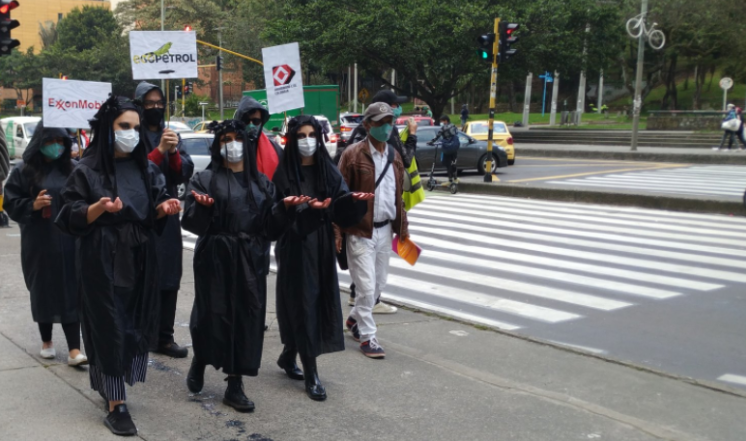
A protest against fracking in Bogota on December 11, 2020.
On March 17, El Espectador reported: “The National Hydrocarbons Agency (ANH) reported that ExxonMobil submitted a proposal to carry out a research project called ‘Platero’, which would be developed in the sedimentary basin Valle Medio del Magdalena and consists of a pilot of the technique commonly known as ‘fracking’.”
Reuters adds: “ExxonMobil confirmed in an email it had submitted a proposal to the ANH, but did not elaborate.”
For now, we know little about ExxonMobil’s proposal other than the ANH has until March 29 to evaluate and qualify the proposal. The ANH has also stated that it will award a second round of contracts for fracking pilot projects on April 8.
ExxonMobil has highlighted that their “practices reflect the spirit and intent of the United Nations’ Universal Declaration of Human Rights and are guided by elements of the United Nations’ Guiding Principles on Business and Human Rights.”
But there are reasons for concern.
Five things to know about ExxonMobil
1- Last month, Oil Change International stated: “ExxonMobil is still searching for more oil and gas that can never be burned. It is still planning new extraction projects, and has no plans to decline production or develop at 1.5ºC-alignment long-term phase out plan.”
2- Last October, The Washington Post reported: “Leaked documents showed that the oil giant projected yearly direct emissions to increase by 17 percent by 2025.”
3- Reuters has reported: “Villagers sought to hold Exxon Mobil responsible for having retained soldiers from Indonesia’s military as guards for a natural gas facility in Aceh, despite knowing of past human rights abuses by Indonesia’s army and that the contract would lead to human rights violations against Aceh villagers.”
4- The Los Angeles Times has reported: “A coalition of state attorneys general and the Securities and Exchange Commission are investigating whether the company lied to the public and investors about what it knew about the dangers of climate change.”
5- Forbes has reported ExxonMobil spends about $41 million a year “to control, delay or block binding climate-motivated policy,” according to research by Influence Map.
Recently, the United Nations Special Rapporteur on human rights and the environment (David R. Boyd), the UN Special Rapporteur on toxics and human rights (Marcos A. Orellana), and the Special Rapporteur on Economic, Social, Cultural and Environmental Rights of the Inter-American Commission on Human Rights (Soledad García Muñoz) have called on the Colombian government to prohibit fracking.
Last month, an Oil Barometer poll found that 73 per cent of Colombians would not agree with fracking being carried out in their municipality and that 69 per cent of people in Puerto Wilches (in the Magdalena Medio) also disagree with fracking.
The Platero project
It is not known if the ExxonMobil ‘Platero’ project refers to the VMM-37 block it holds near Puerto Wilches, Santander. If it is, 30 per cent of that holding is held by Toronto-based Sintana Energy (and its Colombian subsidiary Patriot Energy).
We do know that Petroguia has reported: “Ecopetrol and the US company ExxonMobil signed a memorandum of understanding to work together on the development of one of the pilot fracking projects in the municipality of Puerto Wilches [that] will allow them to be ready for October 2020, the date on which the National Hydrocarbons Agency plans to open calls for pilot plans for the development of unconventional deposits.”
Peace Brigades International-Canada is following fracking in Colombia in relation to the threats being received by environmental defenders opposed to fracking (notably in the Magdalena Medio region); the impact of fracking on the human right to water; and in the broader context of climate breakdown as a violation of the right to a safe environment.
Image by Podion.

