


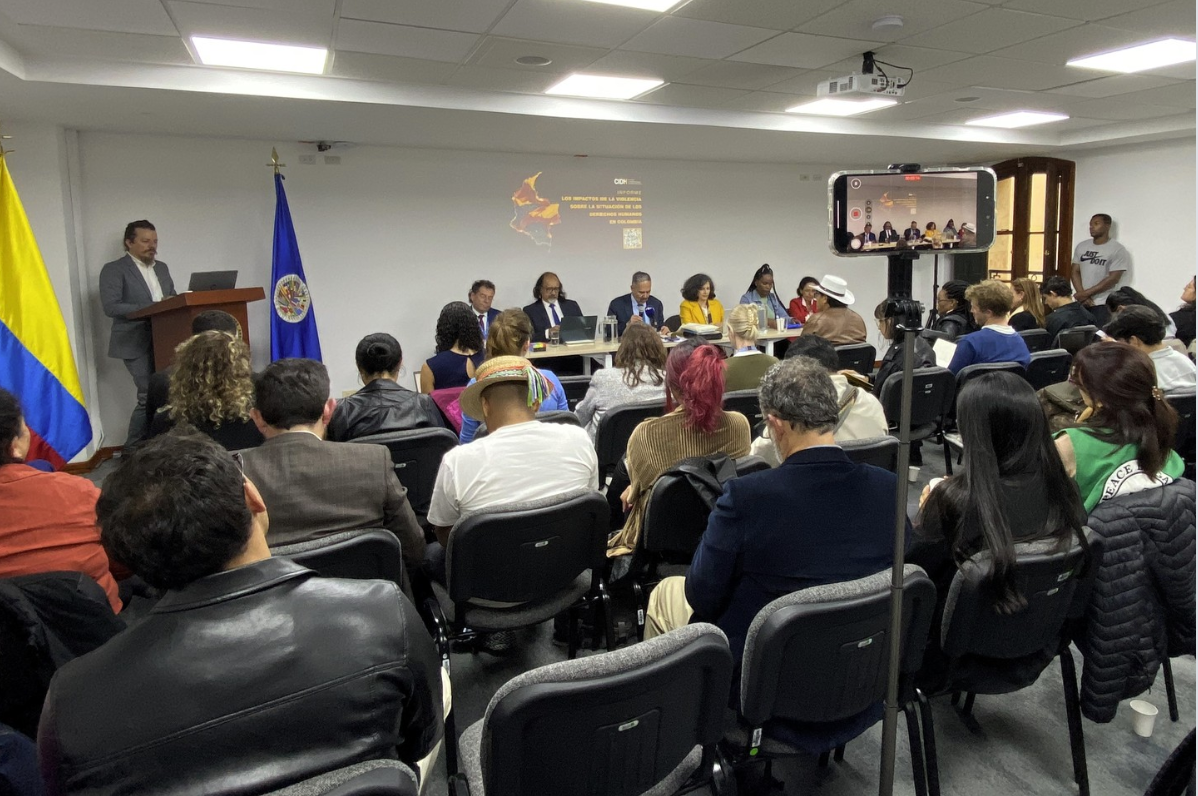
The Peace Brigades International-Colombia Project has posted on social media: “We attend the presentation of the CIDH [Inter-American Commission on Human Rights] report on the impact of human rights violations.”
Caracol Radio reports: “The Inter-American Commission on Human Rights (IACHR) presented a report on the situation of violence in Colombia and the impact it has on human rights. It concludes that, despite the progress and efforts to build peace, there are still structural factors such as inequality, discrimination and the absence of the State in large areas of the territory.”
The report includes references to “the persecution of labour unions” (89), notes that the mining and energy sector has “labour impacts” (293), and that changes introduced to the Victims Law in 2024 aimed to ensure the State provides protection measures for members of labour unions (441):
89- High levels of informal employment are linked, among other factors, to the deterioration and persecution of labour unions. In a context marked by precariousness, stigmatization, and violence, civil society representatives pointed out that the difficulties in defending labor rights translate into a greater likelihood of violations of the legal framework. This scenario also generates a power imbalance between workers and companies, which further increases violations of current regulations regarding labor, environmental, social, and economic rights.
293- The mining and energy sector has generated increasing territorial tensions due to its labour and environmental impacts. Social conflicts related to this sector increased from 89 episodes in 2022 to 130 cases in 2023.
440- In 2024, Law 2421 was approved, reforming the Victims’ Law to strengthen the enforceability of the rights of victims of the armed conflict and eliminate barriers to access to recognition and comprehensive reparation.
441- The reform also implemented differentiated approaches to recognize the impacts on Indigenous people, Afro-descendants, rural communities, women, LGBTI people, people with disabilities, displaced persons, and incarcerated individuals. The changes introduced by the law aim to ensure that the State provides protection measures for women, youth, children, older persons, people with disabilities, rural communities, human rights defenders and social and religious leaders, members of labour unions, and victims of internal, rural, and transnational forced displacement. Similarly, protection policies will prioritize single mothers, victims of sexual violence in the context of armed conflict, and children orphaned by armed conflict. Furthermore, it gave central importance to human security by understanding the interrelationship between security, socioeconomic development, and the enjoyment of human rights.
The full report can be read here.
We continue to follow this.

