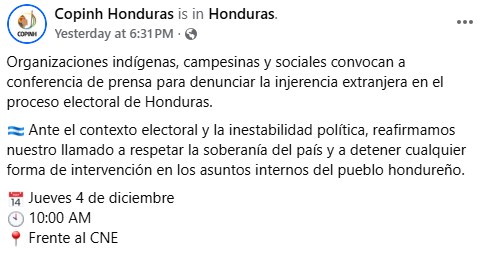
The Peace Brigades International-Honduras Project has posted on social media:
“Today, we accompany several peasant and indigenous organizations in a press conference, march and stand in front of the United States Embassy in Tegucigalpa. During the activity, the organizations opposed the alleged interference of the United States government in the electoral process of Honduras. Also, they showed concern for the pardon granted to Juan Orlando Hernandez, the former president of Honduras who in the United States was sentenced to 45 years in prison for crimes related to drug trafficking. Meanwhile, counting of votes from the general election last November 30 is still ongoing.”
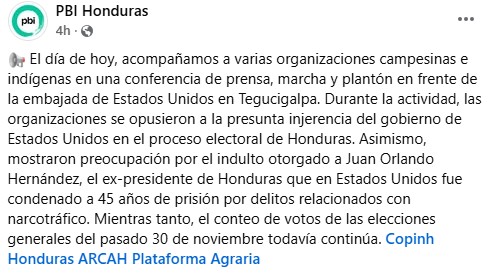
Yesterday (December 3), the Civic Council of Popular and Indigenous Organizations of Honduras (COPINH) also posted:
“Indigenous, peasant and social organizations call press conference to denounce foreign interference in Honduras electoral process.
In the face of the electoral context and political instability, we reaffirm our call to respect the sovereignty of the country and to stop any form of interference in the internal affairs of the Honduran people.”
Today COPINH posted these live video feeds (here and here) on Facebook.
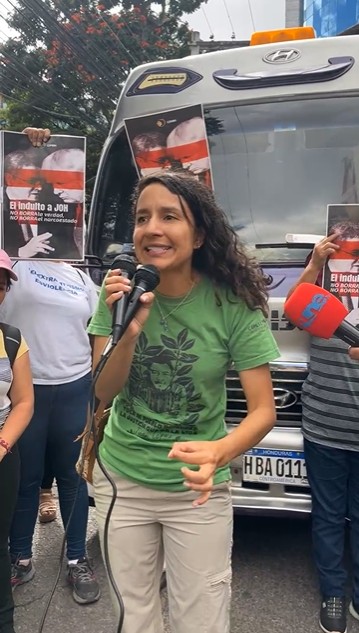
Berta Zúniga Cáceres, the general coordinator of COPINH, says: “The results of this electoral process [reflect] a certain level of fraud that has been denounced, lack of awareness in the country at the time of voting, and part of the fear sown by Donald Trump’s words in the Honduran people.”
The Spanish news agency EFE now reports:
“A group of COPINH members protested Thursday in front of the U.S. Embassy in Tegucigalpa against the pardon granted by U.S. President Donald Trump to former President Juan Orlando Hernández (2014-2022), who had been sentenced to 45 years in prison for drug trafficking.
‘We are here condemning this act of Donald Trump who, by the way, contradicts himself because he expresses that he is fighting drug trafficking that has fallen into murdering people in the Caribbean,’ Salvador Edgardo Zúniga Del Cid, ex-husband of the environmentalist murdered Berta Cáceres in 2016, told EFE.
‘Juan Orlando Hernández, a person linked to drug trafficking and the subsequent coup d’état with many crimes that have been committed in this country, where there are many martyrs,’ said Carol Hernández, a member of that committee.”
The presidential election
Earlier this week, The Guardian reported:
“A former president of Honduras [Juan Orlando Hernández] who was convicted of drug trafficking has walked free from a US prison after receiving a pardon from Donald Trump, as the country’s presidential election remained on a knife edge with the US-backed candidate leading by 515 votes.
The pardon was issued amid extraordinary levels of US interference in the Honduran election. Trump threw his support behind Hernández’s ally Nasry ‘Tito’ Asfura, saying Washington’s support for the country was conditional on an Asfura victory.
On Tuesday [December 2], Trump again intervened, alleging without evidence that electoral officials were “trying to change” the result of Sunday’s vote and said: ‘If they do, there will be hell to pay!’
The virtual vote count had been slow and unstable before it was interrupted at about midday on Monday [December 1]. The electoral council said a technical problem was to blame and insisted the manual count was continuing.
When the release of results was suspended, Asfura was on 39.91%, closely followed by Salvador Nasralla of the Liberal party on 39.89%. Rixi Moncada, the candidate for the leftwing ruling party, was trailing in a distant third place with 19.16% of the vote.”
Today, Reuters reports: “On Thursday [December 4], the National Party’s Asfura held 40.27%, about 24,400 votes ahead of the Liberal Party’s Nasralla, who had 39.38%. Rixi Moncada of the ruling leftist LIBRE Party remained well behind in third place in the election, which was held on Sunday [November 30].”
COPINH commentary
Just a few moments ago, COPINH posted on social media:
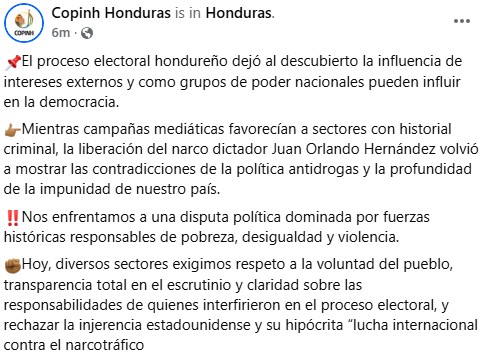
“The Honduran electoral process exposed the influence of external interests and how national power groups can influence democracy.
While media campaigns favored sectors with criminal history, the release of the narco dictator Juan Orlando Hernandez again showed the contradictions of anti-drug policy and the depth of our country’s impunity.
We face a political dispute dominated by historical forces responsible for poverty, inequality and violence.
Today, various sectors demand respect for the will of the people, complete transparency in the screening and clarity on the responsibilities of those who interfered in the electoral process, and reject American interference and its hypocritical “international fight against drug trafficking.”
Canada and Honduras
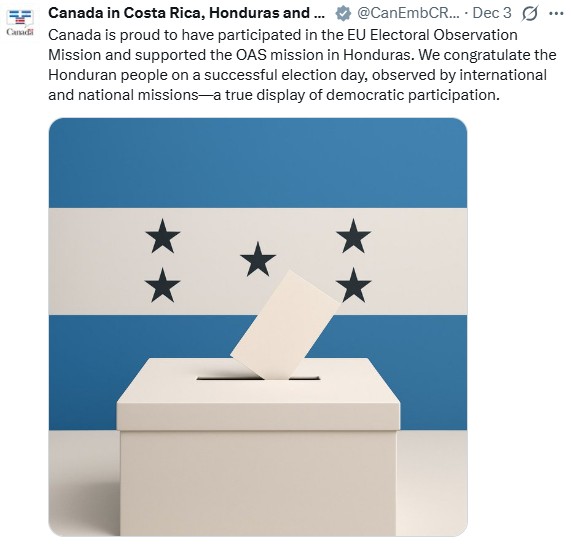
On December 3, the Embassy of Canada in Costa Rica, Honduras and Nicaragua (located in San Jose, Costa Rica) posted on social media: “Canada is proud to have participated in the EU Electoral Observation Mission and supported the OAS mission in Honduras. We congratulate the Honduran people on a successful election day, observed by international and national missions—a true display of democratic participation.”
Accompaniment
COPINH co-founder Berta Cáceres was murdered on March 2, 2016, for her opposition to the construction of a hydroelectric dam on the Gualcarque River. COPINH’s coordinators have been accompanied by PBI-Honduras since May 2016.