


Image from Corporación Jurídica Libertad on Facebook.
Today, the Peace Brigades International-Colombia Project amplified these social media posts on Instagram.
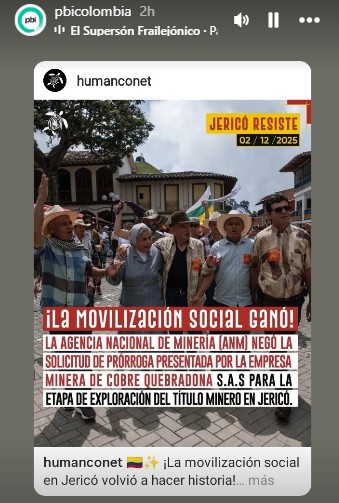
The Human Conet, Juntos SOMOS post highlights: “Today, December 2, 2025, the National Mining Agency (ANM) denied the application for extension to the mining title of the Québradona copper project in Jericho and Thames (Antioquia). …This means that the exploration stage can’t be extended.”
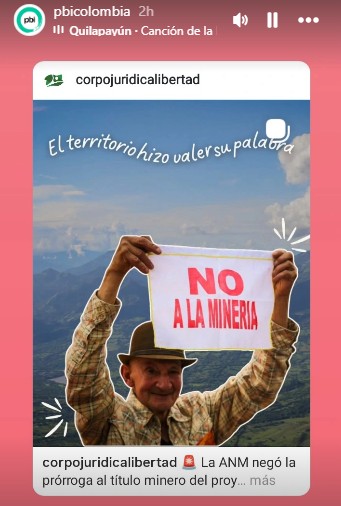
And the Corporation for Judicial Freedom (CJL) post affirms: “This decision doesn’t come out of nowhere, it’s the result of years of resistance, complaints, community studies, assemblies, social mobilization and water advocacy by farmworkers youth, leadership, groups and communities that stood firm even when everything was against. …As long as the title remains in force and extractive pressure continues, the territorial organization will also follow. This is a historic achievement, but it’s not the end.”
Peace Brigades International has accompanied the Corporation for Judicial Freedom (CJL) since 2000.
Background on Quebradona
In July 2025, The Guardian reported: “[Argiro] Tobón, who has spent years harvesting coffee beans, is among 11 local farmers and environmental activists facing a lawsuit initiated by the South African mining company AngloGold Ashanti. Accused of kidnapping, theft and personal injury, they were charged after a series of protests against the company’s proposed Quebradona copper mine, which activists believe poses a serious threat to the environment and agrarian economy.”
“The conflict between the company and regional communities has been escalating since the end of 2023. The kidnapping charge stems from an incident that year, when a group of protesters disrupted an unauthorised excavation by AngloGold, contacting the mayor’s office, police and local ombudsman, and stopping the miners working. A similar incident in 2023 involved more than 150 farmers entering private land where AngloGold was drilling, removing machinery and handing it over to the authorities. This led to charges of theft and later of personal injury, after a miner was bitten by a farmer’s dog.”
“Protesters presume that, with its exploration licence set to expire in December, AngloGold is growing increasingly desperate to get permission to mine with an exploitation licence from Colombia’s National Authority for Environmental Licences (ANLA). A previous application was suspended in 2021 due to a lack of data.”
That article also noted: “So far, AngloGold continues its legal actions against the protesters. On 16 June, Argiro Tobón and his companions left the Jericó court to cheers and applause from a crowd after a judge ruled they would not be placed under house arrest during the trial. Despite this initial victory, a long road lies ahead for the accused farmers. With the full extent of the legal process yet to come, their fate, and that of the land they have worked for decades, remains undecided.”
Accompaniment
PBI-Colombia has previously noted:
“Corporation for Judicial Freedom (CJL) members have been subjected to different forms of threats and attacks throughout the organisation’s existence. These include death threats as a result of their human rights defence work, and attempts to link its members to criminal proceedings as part of judicial setups.
Since mid-2019, the Corporation has detected illegal interceptions and illegal followings, and during the social protests at the end of that year, unjustified actions were taken by the authorities against some lawyers, including false accusations and attempts to detain them.”
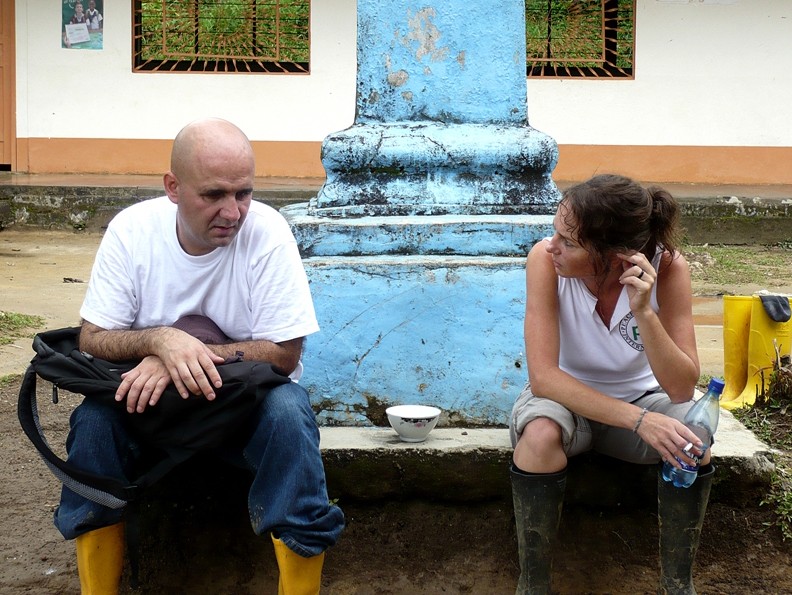
Photo: PBI-Colombia with CJL founder Elkin Ramírez.
Canadian mining in Colombia
This past October, Mining.com reported: “Colombia currently hosts only one large-scale copper mine, El Roble, operated by Canada’s Atico Mining (TSX-V: ATY) in Chocó. While at least eight copper projects are in development, regulatory shifts have clouded their future.”
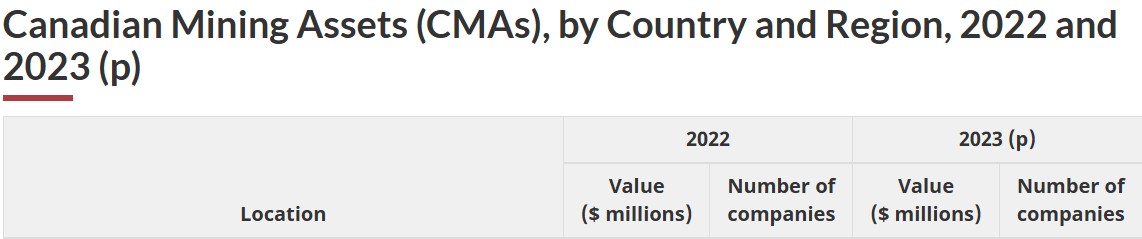
In February 2025, Natural Resources Canada published this chart on “Canadian Mining Assets” in Colombia.

PBI-Colombia has previously explained: “The abundance of natural resources [in northeast Antioquia] and the arrival of multinational companies, such as the Canadian Gran Colombia Gold, has provided the illegal armed groups who are present in the region with an extremely lucrative funding source in mining.”
In December 2024, Lital Khaikin reported in the independent media outlet The Breach: “Gran Colombia Gold merged into Vancouver-based Aris Mining in 2022, and continues to operate the Segovia mine in Antioquia, an underground mine currently being expanded to produce over 300,000 ounces of gold per year.”
She added: “Canadian multinationals like Aris Mining and Quimbaya Gold have entangled themselves in a community already deeply marked by human right abuses, cartel networks, and sustained armed conflict.”
She also noted: “As The Breach previously reported, Gran Colombia has worked with sub-contractors that are implicated in laundering illegal gold into legal markets and have ties to right-wing paramilitaries.”
Khaikin concluded: “Canadian companies are relying on contract mining amid poor regulation, expanding without community consent into unprotected areas, and continuing to source gold in a murky territory run by Colombia’s most powerful cartel—all amid what the UN Refugee Agency has described as a deteriorating humanitarian situation.”
PBI-Canada continues to follow the struggles of accompanied organizations, defenders and communities in Colombia.

