Video still: To listen to the NB Media Co-op’s interview with Wolastoq Elder Alma Brooks and Wolastoq Grand Chief Ron Tremblay who is also known as Spasaqit Possesom, please click here.
Yesterday, Prime Minister Mark Carney announced Canada’s participation in Security Action for Europe (SAFE).
Significantly, that statement highlighted: “As all 27 EU [European Union] Member States increase defence investments, greater cooperation on procurement opens massive new opportunities for Canadian manufacturers to build and export Canadian-made technologies and capabilities.”
Politico explains: “Canada’s accession to the loan-for-weapons SAFE scheme gives Ottawa access to jointly financed defense projects and allows Canadian companies to bid into EU-supported joint procurement projects. For Brussels, securing a G7 partner strengthens the credibility of SAFE as it seeks to coordinate long-term weapons demand and ramp up Europe’s defense industrial base.”
And Canadian Defence Minister David McGuinty says: “This will allow Canada, for example, to participate by supplying capabilities such as ammunition, missiles, drones, artillery systems, infantry weapons and beyond.”
Just three weeks prior, on November 10, 2025, CBC News also reported: “Finance Minister François-Philippe Champagne says his goal is to help make Canada the NATO partner of choice when it comes to supplying critical minerals as defence becomes a focus for many countries.”
This relationship between the mining of critical minerals and “defence production” in Canada has also been seen in various announcements over recent months including the G7 Critical Minerals Action Plan (June 2025), the critical minerals partnership with Germany (August 2025), the “strategic projects” under the Critical Minerals Production Alliance (October 2025), and the $2 billion allocated in Budget 2025 to create a Critical Minerals Sovereign Fund (November 2025).
These critical minerals could come from proposed mines in the Golden Triangle area of British Columbia (powered by the proposed North Coast Transmission Line), the Ring of Fire in Ontario, and New Brunswick.
The major projects announcements made by Prime Minister Carney on September 11, 2025 and November 13, 2025 have also highlighted this relationship.
Wolastoq Grand Council rejects the Sisson Mine
For example, the November announcement included the Northcliff Resources’ Sisson Mine in Sisson Brook, New Brunswick that would produce tungsten.
On May 1, 2025, Northcliff itself had announced that it had been awarded US $15 million from the United States Department of Defense (rebranded as the Department of War in September 2025) to develop the mine.
This past summer, the NB Media Co-op reported: “[That] news has provoked indignation from Indigenous Elders who oppose the project, including Wolastoq Grand Chief Ron Tremblay. The Wolastoqey Grand Council represents a traditional governance structure with a grassroots constituency.”
That article continues: “Tremblay said the Wolastoq Grand Council rejects activities contributing to war and what he called the ‘continuum of genocide’ in places such as the Gaza Strip and the West Bank. …[Alma Brooks, a Wolastoq Elder also] pointed to Israel’s prolonged and devastating U.S.-backed assault on the Gaza Strip, ‘a genocide that’s happening right under the nose of the world’…”
Major projects in “the national interest”
The Carney government’s recommendation that the Sisson Mine be fast-tracked by the Major Projects Office (MPO) suggests this mine is seen as a “nation-building project” that is “the national interest”.
This past October, Stephen Fuhr, the Secretary of State for Defence Procurement, also stated: “Designating critical minerals as essential to Canada’s national interests under the Defence Production Act is a decisive step in protecting the sovereignty of our strategic resources. This measure deepens Canada’s strategic alignment with NATO and our allies, strengthens supply chain resilience and secures reliable access to the resources our domestic defence industry depends on.”
Safety concerns for land defenders
The potential clash between “national interest” designation and the assertion of Indigenous rights is cause for concern.
PBI-Canada recalls the Royal Canadian Mounted Police (RCMP) actions against anti-fracking protests in New Brunswick.
Photo: “RCMP Emergency Response Team members during early morning raid on camp, Oct 17, 2013.” Photo from Warrior Publications.
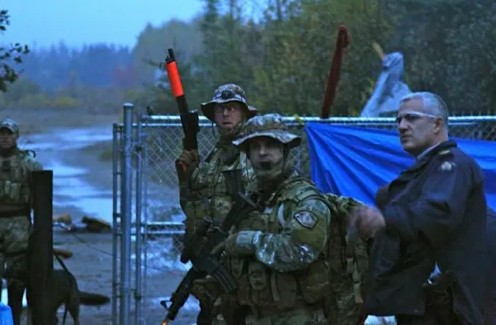
Photo: “RCMP bring 60 drawn guns, dogs, assault rifles, to serve injunction on the wrong road” Photo by Miles Howe/ Halifax Media Co-op.
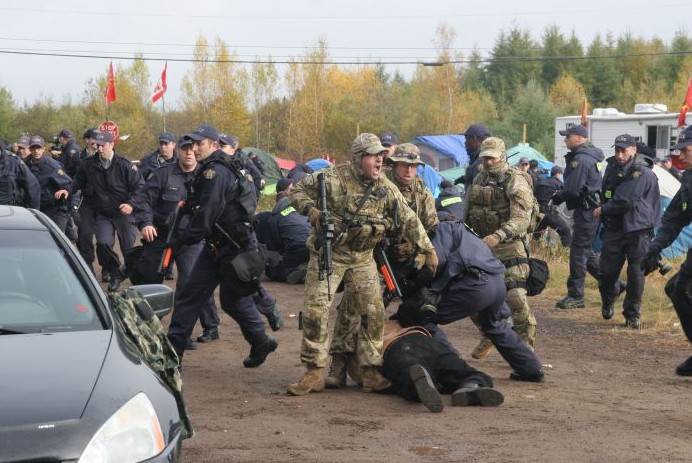
APTN News has reported: “Mi’kmaw resistance to local exploration by Texas-based SWN Resources began in June 2013, escalated through the summer and eventually led to a blockade and land occupation that halted work. The standoff culminated in an Oct. 17 police raid in which camouflage-clad Mounties with assault rifles, riot control shotguns and canine units descended on the camp and arrested over 40 people.”
A report issued in November 2020 by the Civilian Review and Complaints Commission (CRCC) concluded: “Several incidents or practices interfered to varying degrees with the protesters’ rights to freedom of expression, association and peaceful assembly. That report also noted that some of the RCMP’s surveillance practices and physical searches were “inconsistent with protesters’ charter rights to be free from unreasonable search and seizure.”
Several years after the October 17, 2013 raid, the C-IRG was formed.
According to the RCMP: “The Community-Industry Response Group (C-IRG) was created in 2017 to provide strategic oversight addressing energy industry incidents and related public order, national security and crime issues.”
Following the launch of a CRCC systemic investigation of the C-IRG in March 2023 after nearly 500 complaints against it, the unit was rebranded the Critical Response Unit-British Columbia (CRU-BC) on January 1, 2024.
We continue to follow this.